
This past Sunday, on the International Day of the Victims of Enforced Disappearances, I sat beside the president of Syria’s National Commission for Missing Persons at its headquarters in Damascus for a historic moment: the launch of a platform through which families will be able to report their missing loved ones. For Syrian families, August 30 has long been a day to remember those who were disappeared and renew their demand for truth and answers. This year, marking it inside a Syrian institution created to search for them had a very different significance.
For more than a decade, Syrian families largely carried out that search themselves. They documented cases, preserved evidence and memory, formed associations, supported one another, and continued demanding answers from a government that was itself responsible for the disappearance of tens of thousands of Syrians.
My own journey at ICTJ over the last 10 years has been closely intertwined with theirs. We have worked alongside Syrian families, victims’ groups, and civil society organizations in Lebanon, Turkey, Europe, and elsewhere, supporting their advocacy and efforts to lay the groundwork for a future justice process in Syria.
One principle always remained constant: Families have the right to know what happened to their loved ones. Searching for the missing cannot be their responsibility alone; it is a responsibility of the state.
After the fall of the Assad regime, that demand finally had a new place to be heard. On February 1, 2025, ICTJ facilitated the first meeting between families of Syria’s missing, disappeared, and detained and President Ahmed al-Sharaa and Foreign Minister Asaad al-Shaibani at the Presidential Palace in Damascus. Families came with concrete demands, including the creation of a national body capable of taking responsibility for the search. President al-Sharaa committed that day to establishing such a body. Today, that body exists.
I have had the honor of accompanying the National Commission for Missing Persons since day one, as ICTJ worked with it to turn that commitment into an institution capable of delivering answers to families.
Importantly, the commission has sought to involve families in shaping its mandate and what it would look like in practice. Beginning last year, it launched consultations with families and civil society to understand their needs and priorities and solicit their input. These consultations continue across Syria today and will soon extend to neighboring countries and Europe as part of work on a law on missing persons. We are proud to support and participate in this process.
This is how building genuine trust begins. Families should not simply provide information; their knowledge and experience should inform the institutions meant to serve them. We have seen this across ICTJ’s work from Lebanon to Colombia to Nepal: Institutions must not only work for families, but with them.
The launch of the platform makes that work tangible. Families, who still each day must deal with the unspeakable grief of losing someone to the unknown, now have a concrete entry point into a Syrian national process established to search for their loved ones.
At the heart of that search must be the fundamental principle: Every missing Syrian matters, and every family has the same right to an answer, regardless of identity or affiliation, who was responsible for the disappearance, or when it occurred.
If the commission translates this principle into practice, its impact can extend beyond individual cases. It can help rebuild trust between Syrians and state institutions, contribute to justice and lasting peace, and offer an example of what it means to put victims and their rights at the center.
The August 30 event, which brought together the commission’s president, the minister of justice, partners, and families of the missing, also reminded us why this work remains urgent. At it, families had the opportunity to voice their demands and deliver a particularly important message.
Since the fall of the Assad regime, Syria has seen new cases of disappearances. Families who know intimately the pain of not knowing the fate of a loved one were clear: What happened to them cannot be allowed to happen to another generation of Syrians.
Sitting there, I thought about the many August 30s Syrian families have marked over the years, demanding that their loved ones not be forgotten. I thought about our meeting at the Presidential Palace in February 2025. Now, we were sitting inside a Syrian national institution whose existence reflects one of the demands families had expressed for years.
There is a long road between establishing an institution and giving families the answers they deserve. But the launch of the platform on this symbolic day was also a moment to recognize how far we have come. For years, Syrian families led the search for their loved ones. Today, there is finally a national institution dedicated to it.
For me, August 30 has always meant searching for every missing person, standing with families in their demand for truth, and building strong and lasting institutions that we can trust and ensuring that no more families are forced to begin this same search. That is how “never again” becomes more than a promise.
________
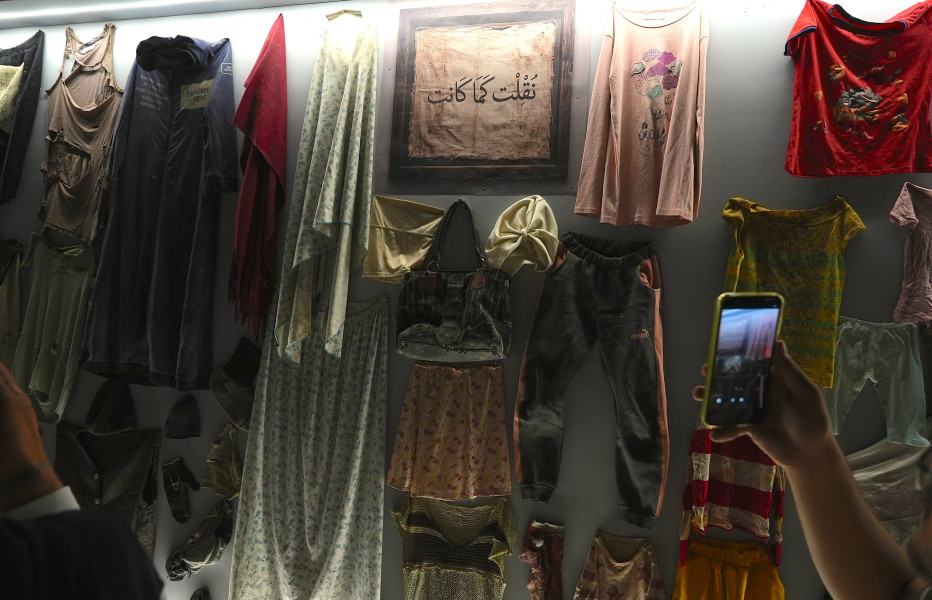
PHOTO: Clothing belonging to former detainees in Syrian prisons, including women, children, and men, is displayed in the Syrian Prison Museum's pavilion at the 63rd Damascus International Fair in Damascus, Syria, on August 29, 2026. (Abedalbaset Alhasan/ICTJ)