629 results

As new evidence of past violations comes to light, Afghanistan must prioritize transitional justice measures to break the cycle of abuse. ICTJ's new briefing paper provides analysis of past reports identifying the patterns of abuses and puts forth recommendations to the government of Afghanistan.

In collaboration with the Brookings-LSE Project on Internal Displacement, ICTJ’s Research Unit examined how transitional justice can be used to address the range of injustices associated with displacement and thereby serve as part of a comprehensive approach to the resolution of displ...

As Colombia marked International Justice Day, the importance of accountability for violations committed during the decades of conflict was underscored in the number of victims awaiting justice—376,000 registered in the Attorney General’s Office, more than 4 million in total. And while July 17 is celebrated as the date of adoption of the Rome Statute of the International Criminal Court, it is clear that in countries like Colombia accountability extends beyond criminal trials.

Following post-election violence in 2007–2008, Kenya faced a need to hold accountable those most responsible for the fighting that resulted in more than 1,000 deaths and widespread property destruction and displacement. But national judicial mechanisms proved reticent to do so, and in 2010, the situation was adopted by the ICC, who in January of 2012 announced indictments against four suspects.

Though not a state party to the Rome Statute, Cote d’Ivoire accepted the jurisdiction of the ICC through an ad hoc declaration in April 2003, and in December of 2010—in the wake of the post-election crisis—reaffirmed that declaration. It has been more than one year since Cote d’Ivoire began a critical transition from a decade-long civil war that divided the country and led to widespread human rights violations, forced displacement, and loss of civilian lives and property.

As we mark July 17, designated International Justice Day by the states parties of the International Criminal Court (ICC) just over two years ago, we should not limit our focus to the work of the court or criminal justice as such. Pursuing justice in the aftermath of atrocity presents an opportunity to do three crucial things: reaffirm a society’s shared values about basic ideas of right and wrong; restore confidence in the institutions of the state charged with protecting fundamental rights and freedoms; and recognize the human dignity of the victims of atrocities that have taken place.

Why pursue transitional justice in the aftermath of massive human rights violations? “The Case for Justice” provides a window into the debate about the relevance of transitional justice in today’s world.

After several months of intense political debate, Colombia’s Senate passed constitutional reform measures containing extensive transitional justice provisions. The Legal Framework for Peace was adopted to confront decades of massive human rights violations and help to bring a sustainable peace to Colombia’s ongoing internal armed conflict.

On June 29, the government of Maine joined chiefs from the state's five tribes to sign an agreement creating the Wabanaki-State Child Welfare Truth and Reconciliation Commission. Eduardo Gonzalez, director of ICTJ's Truth and Memory Program, attended the signing ceremony, and spoke about its importance—both local and global—in an interview with the Maine Public Broadcasting Network. Listen to the interview MPBN 04:54min

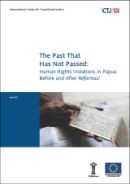
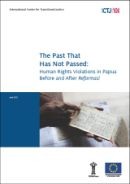
This joint report released today by the International Center for Transitional Justice (ICTJ) and the Institute for Human Rights Study and Advocacy (ELSHAM-Papua) provides important insight into the ongoing debate on steps required to achieve a sustainable peace in Papua. The report reviews Papua's recent history within a transitional justice framework, and provides expert recommendations on truth seeking, justice, reparations, institutional reform, and enforcing the rights of women victims.

This joint report by ICTJ and the Institute for Human Rights Study and Advocacy (ELSHAM-Papua) provides important insight into the ongoing debate on steps required to achieve a sustainable peace in Papua. The report reviews Papua's recent history within a transitional justice framewor...

Granito: How to Nail a Dictator, a recent documentary from Skylight Pictures, shows the international effort that has worked tirelessly to bring Montt to account for his crimes. ICTJ is pleased to announce that Granito will be aired on Thursday, June 28 at 10pm on the PBS series P.O.V.

As Yemen prepares to embark on a national dialogue about its future, addressing the legacy of the past human rights violations remains one of its key challenges. A Law on Transitional Justice and National Reconciliation has been under discussion since February 2012 and may now be adopted in the coming weeks.

The Truth and Reconciliation Commission (TRC) of Canada held its fourth national event in Saskatoon, Saskatchewan June 21. After attending a prior hearing, students from the We'koqma'q Mi'kmaw School in Nova Scotia created “Our Legacy Our Hope,” a documentary bearing witness to the intergenerational effects of Residential Schools and the ongoing work of the commission to address these legacies.

Almost 150 criminals, racist killers, and those responsible for mass atrocities committed during and immediately after apartheid have been recommended for special pardon in a deeply flawed and unconstitutional process headed by President Jacob Zuma, the South African Coalition for Transitional Justice (SACTJ) warned today.

Under what conditions can truth commissions make a positive contribution to gender justice? How can they put in place a friendly process for children? Can they contribute to the rights of indigenous peoples? ICTJ, in partnership with the Barcelona International Peace Resource Center, is pleased to announce the 4th Intensive Course on Truth Commissions, focused this year on the challenge of recognizing the experiences of vulnerable populations in the work of truth commissions.

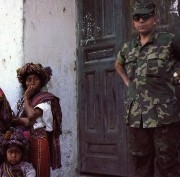
In societies confronting the legacies of war, tyranny, or entrenched injustice, the experiences of indigenous people have often been marginalized. ICTJ has published a handbook offering guidance on planning truth commissions and commissions of inquiry that safeguard the interests of indigenous communities and address violations against them.

ICTJ welcomes the appointment of seven distinguished experts as members of the Brazilian National Truth Commission. The government has taken a historic step to honor victims and ensure the people of Brazil know the full truth about the human rights abuses committed in their country; the pursuit of justice can only make Brazilian democracy stronger.

In seeking to establish accountability for past atrocity, many transitional justice mandates have also sought to redress crimes against indigenous populations. To further explore this relationship, ICTJ and our partners in Canada and Colombia are holding two side events to the UN Permanent Forum on Indigenous Issues.

Indigenous peoples are among those most affected by contemporary conflict. The resource-rich territories they occupy are coveted by powerful, often violent groups. Their identity is perceived with mistrust, sometimes with hate. Indigenous communities live at a precarious intersection ...

As ArcelorMittal, the world’s largest steel company, invests 19.2 million pounds of steel to construct a monument marking London’s Olympic Games, a disturbing story is emerging about the refusal to memorialize a former concentration camp in Bosnia it owns today. Not only is ArcelorMittal unwilling to provide even a fraction of the cost of the London “Orbit” to commemorate the suffering of Bosnians in the notorious Omarska camp, but it has recently started denying victims access to the site.

The National Conference to Launch a Dialogue on Transitional Justice in Tunisia was held on Saturday, April 14 in Tunis, initiating a process which should result in the adoption of a comprehensive law on transitional justice by the country’s National Constituent Assembly. ICTJ president David Tolbert delivered a keynote address.

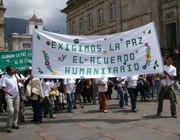
On April 9, Colombia commemorated for the first time the National Day of the Memory and Solidarity with the Victims. This photo gallery collects the expressions of commemoration that took place in three cities in the country: Bogotá, Medellín and Villavicencio.

Colombia marked the country’s first National Day of Memory and Solidarity with the Victims April 9. For the millions who have suffered human rights violations in Colombia’s entrenched armed conflict, this was a day for their voices to be heard and their suffering to be acknowledged by the state; a nationwide call for accountability and reconciliation in a highly divided society.

Last month ICTJ, with Saint Joseph University’s Modern Arab World Research Center and UMAM Documentation and Research launched the website “ Badna Naaref” (We Want to Know). This oral history project conducted by students tells the stories of suffering and survival during the war in Lebanon, serving both to commemorate and educate.