


726 results

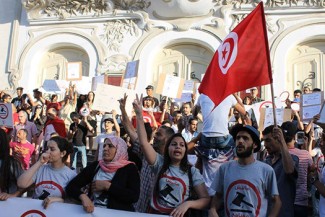
Members of parliament from political parties opposed to extending the work of Tunisia’s truth commission today voted to end the commission’s mandate. This came after parliamentarians from parties that support the extension walked out of the proceedings because their position is that the Organic Law that created the Truth and Dignity Commission (TDC or Instance Vérité et Dignité in French) authorized the TDC to extend its mandate. Earlier, the TDC had voted to extend its mandate by a year in order to complete its work. In a position paper distributed to members of parliament and civil society activists, ICTJ and the Victims’ Coalition for Dignity and Rehabilitation jointly said that they supported the extension of the TDC’s mandate, despite internal issues among its commissioners. ICTJ pointed out that other truth commissions elsewhere have sought and been given extensions in order to carry out key parts of their work, such as public hearings, or to complete writing their reports. Both ICTJ and the Victims’ Coalition said that an extension would allow the TDC to hold public hearings on marginalization and unemployment – which was one of the grievances that drove the Arab Spring in Tunisia. It would also give the Commission time to finalize its report and recommendations, including those on reparations.

ICTJ announces the departure of David Tolbert, President of the ICTJ, after eight years of service. David Tolbert was appointed president of ICTJ in March of 2010. He led the center’s evolution as it continued to pursue justice around the globe in changing times. ICTJ’s Executive Director, Fernando Travesi, will assume leadership of ICTJ following Tolbert’s departure at the end of March 2018.

Sixteen practitioners participated in the Intensive Course on Transitional Justice and Peace Processes held in New York from March 5 to March 9, 2018. Participants included leaders in their respective fields, including human rights law, community justice and legal services, peacebuilding, education, and humanitarian affairs. Selected course presentations, led by ICTJ experts and other specialists in the field, delved into cases of current, recent, and paradigmatic peace processes and questions of justice within a comparative context.

In recent months, the crisis in the Central African Republic (CAR) that erupted five years ago has seemed farther than ever from resolution. A new report by ICTJ, I Am 100% Central African: Identity and Inclusion in the Experience of Central African Muslim Refugees in Chad and Cameroon, offers important insights on how a higher political commitment to inclusion could help transform a volatile rebuilding process into a sustainable peace.

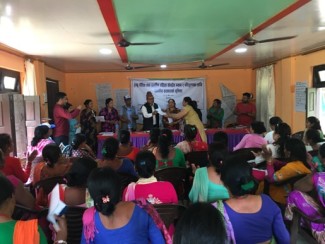
The ICTJ continues to support human rights victims in Nepal in their pursuit of justice, truth, reparations, and institutional reform. This briefing paper presents a summary of findings and recommendations from workshops that ICTJ conducted with women victims, as well as meetings it h...

When the Syrian people took to the streets in March 2011, nobody could have predicted that the ensuing crisis would become the largest international calamity in recent history. Syrians’ calls for freedom and justice, which rode the wave of revolutions in neighboring countries, have be...

In the aftermath of massive human rights violations, the voices of young people carry enormous potential: they can tell the truth about the past while offering new paths forward as their societies pursue peace and justice. However, if institutions want the insights of young people, they must avoid pre-formulated solutions and instead engage with youth on their own terms. A new guide released by ICTJ today aims to provide the tools necessary to do so, offering recommendations about how to responsibly and effectively gather statements from young people.

As human rights advocates and state representatives increasingly acknowledge the necessity of involving children in truth-seeking processes, there is a growing need for practical tools that facilitate children’s participation while prioritizing their protection. This statement-taking ...

On March 22, Syrian victims and activists will gather in Geneva, Switzerland for a public hearing-style event examining the impact of the destruction of schools in the context of the Syrian conflict. The event will be hosted by the International Center for Transitional Justice and the ten Syrian organizations that together comprise the Save Syrian Schools project. A livestream will be available.

Anti-apartheid activist Ahmed Timol died in South African police custody in 1971, and his family continues to demand justice. While police claimed Timol died by suicide, evidence indicated that he was tortured and murdered. The family’s tenacious efforts led to the reopening of an inquest into Timol's death this year, with ICTJ senior program advisor Howard Varney representing the family. Last month the Pretoria High Court ruled in the family’s favor, finding that Timol did not kill himself but was indeed murdered while in police custody. ICTJ’s Sam McCann sat down with Varney to discuss the ruling, what it means to Timol’s family, and its significance for the fight for justice in South Africa.