


49 results

ICTJ releases a new briefing paper, “Reflections on Victim-Centered Accountability in Ukraine.” The paper examines the various actions that have been taken or are under consideration to investigate and prosecute war crimes and other human rights violations in Ukraine. It explores the myriad challenges they face and how tools from the field of transitional justice can be applied in tandem to deliver justice and reparation to victims and lay the foundation for a more inclusive and democratic Ukraine.

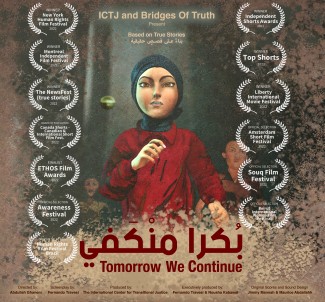
ICTJ and the Bridges of Truth project are launching Tomorrow We Continue, a new short animated documentary that follows a young mother of two whose husband was detained and disappeared by security forces in Syria some years ago. The film takes the viewer on her journey as a refugee searching for safety in Berlin and depicts the daily struggles she encounters once settled as she tries to earn a living and care for her children while continuing to search for her husband. Since the uprising in Syria began in 2011, more than 100,000 people have been disappeared or arbitrarily detained. The families they leave behind may move to safer places as refugees, but the search for their loved ones persists wherever they go. This film is one of their stories.

Kampala, October 17, 2022—Sixteen years after the decades-long conflict between the Ugandan government and the rebel group the Lord’s Resistance Army (LRA) ended, victims continue to grapple with its persistent effects. Victims of conflict-related sexual violence (CRSV) and children born of war, in...

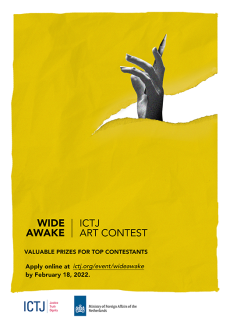
Tunis, March 22, 2022­—The International Center for Transitional Justice (ICTJ) will hold a series of cultural activities from March 21 through March 26, 2022, as part of its Wide Awake Art Contest. The contest, launched in January, invited Lebanese and Tunisian artists, as well as expat artists...

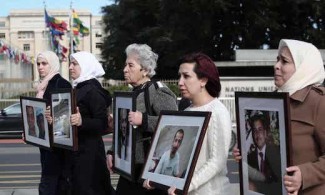
New York, March 1, 2022—“There can be no peace in Syria until the rights of the wrongfully detained, disappeared, and their families are fully restored,” warns a new publication released today by the Bridges of Truth, a collaborative of eight Syrian civil society organizations and ICTJ. A Guide to...

New York, January 21, 2022—ICTJ will host an online course, entitled “Prevention and Guarantees of Non-Recurrence: The Role of Transitional Justice,” from March 14 through 18, 2022. Prevention has emerged as a top priority on international policy agendas for sustainable peace and development and global governance, and understanding the preventive capacity of transitional justice is more imperative than ever.

New York, January 18, 2022— The International Center for Transitional Justice (ICTJ) is pleased to announce the “Wide Awake Art Contest,” an open call to Lebanese and Tunisian artists as well as artists living in Lebanon or Tunisia to explore the theme “the Sound of Dissent.” The contest will showcase works by those who are documenting and memorializing their communities’ stories in times of instability, resistance, and change.

New York, December 10, 2021—In contexts such as Afghanistan, Bosnia, Chechnya, Iraq, Somalia, and Syria, hundreds, sometimes thousands, of individuals have crossed national borders to engage in violent conflicts in which serious human rights violations and mass atrocities have been committed...

New York, March 10, 2021—“We want to turn the page, but not at the cost of justice”—that was a message repeated by victims of human rights abuses interviewed in a new report released today on transitional justice in the Central African Republic (CAR). Produced by the International Center for Transitional Justice and Cordaid, ‘A Drop of Water on a Hot Stone’: Justice for Victims in the Central African Republic presents findings from a study exploring victim-centered approaches to justice in CAR and their feasibility in a context of profound fragility and extreme poverty.

New York, January 25, 2021—"You cannot deliver 500 kilograms of transitional justice,” explains a high-level UN official in a new ICTJ report released today that explores the theoretical and practical challenges of measuring the results of transitional justice processes. These processes are complex and politically contested and are thus notoriously difficult to evaluate. The report offers key insights related to and tools for evaluating and monitoring transitional justice processes and assessing their impact.