611 results

This report summarizes the key observations offered by Syrians during community dialogues in April 2025. Convened by Bridges of Truth, a collaboration of Syrian civil society organizations and ICTJ, the dialogues captured a wide spectrum of perspectives and experiences and provided va...

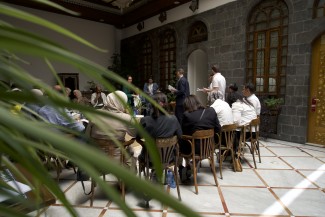
Some 20 people sit in chairs around a table located inside a courtyard.

This document presents a non‐exhaustive summary of some of the topics discussed at a workshop on outreach organized by the ICTJ in collaboration with the ECCC from March 3-5, 2010. It first provides a general overview of the ECCC functions and outreach activities. Thereafter, it highl...

Pablo de Greiff, director of Research at ICTJ, has presented his candidacy for the role of Special Rapporteur for the Promotion of Truth, Justice, Reparation, and Guarantees of Non-Recurrence. This new position is being established by the United Nations Human Rights Council to bring greater attention to accountability for serious crimes and human rights violations.

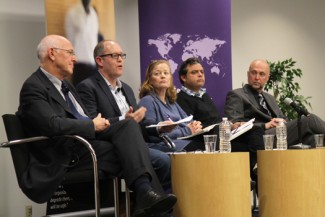
What happens when a state refuses to acknowledge the suffering of victims of mass atrocities? Or when the public celebrates perpetrators as heroes? Earlier this month, a panel discussion hosted by The International Center for Transitional Justice and New York University’s Center for Global Affairs grappled with the impact of denial on justice.

Examples of pardons in international jurisprudence, including Inter-American Court and Commission, European Court of Human Rights, UN Treaty Bodies, and the African Commission on Human and Peoples’ Rights.

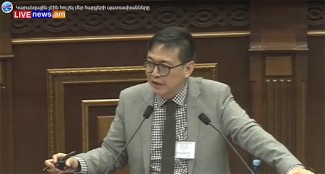
In designing transitional justice in Armenia, policymakers, civil society activists, and international actors should remember those who have not had justice for so long: the families of those killed or injured in March 2008, the victims of torture and political detention, the mothers in black seeking the truth about why their soldier sons were killed, the old pensioners who live in cold and hunger, farmers and rural communities who need access to social services, and students and young citizens who saw that their hope for a better future required a revolution.

An end could be in sight for the longest-running armed conflict in the Western Hemisphere. Peace negotiations between the government and the Revolutionary Armed Forces of Colombia (FARC) rebels have begun on 17 October in Oslo, Norway, and will continue in Havana, Cuba.

While a pardon application process exists within the Department of Justice, the president is free to issue pardons without regard to the process and for any reason, including a desire to shield members of his administration and the military from investigations.

Recent speculation indicates that U.S. President George W. Bush may grant pardons to administration officials and members of the military who might face prosecution for authorizing, ordering, endorsing, justifying or committing acts pursuant to the “war on terror.” While a pardon appl...

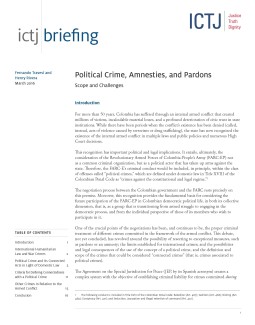
In this briefing paper ICTJ addresses one of the crucial points of the peace negotiations between the Government of Colombia and the Revolutionary Armed Forces of Colombia-People’s Army (FARC-EP): the possibility of providing recourse to the broadest amnesty possible and pardons as pa...