



616 results
Since 2014, conflict in Yemen has caused hundreds of thousands of deaths, displaced millions, destroyed the economy, and exacerbated systemic marginalization, creating one of the world’s worst humanitarian catastrophes. Yet currently, transitional justice and reconciliation take up little space in the Yemeni political arena. In this context, ICTJ has released a new report that explores pathways to a just and sustainable peace in Yemen.

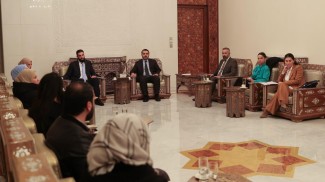
On February 1, 2025, ICTJ facilitated a meeting between family members of the missing and detainees and Syria’s transitional president, Ahmed Al-Sharaa, and the minister of foreign affairs, Asaad Al-Shaibani, at the Presidential Palace in Damascus. Attendees presented a number of specific urgent demands related to the missing and forcibly disappeared, while President Ahmed Al-Sharaa underscored the government’s commitment to the issue.

As part of the new digital campaign "Reparations Build Justice," the ICTJ team would like to share the keynote address given by ICTJ Director of Programs and Deputy Executive Director Anna Myriam Roccatello at a recent conference on issues related to providing reparations through international criminal courts. In her remarks, Roccatello describes the inextricable link between accountability and reparation as well as ICTJ’s unwavering commitment to victims of massive human rights abuses.

On January 22, 2025, ICTJ launched its digital campaign, “Reparations Build Justice”, aiming to raise awareness about reparations and their vital contribution to sustainable peace and justice, particularly in countries grappling with legacies of mass atrocities.

On December 2 to 6, 2024, the International Criminal Court’s (ICC) Assembly of States Parties—the court’s management oversight and legislative body—held its 23rd session in The Hague. As in previous years, ICTJ took an active part, and its experts joined many of the discussions sharing their knowledge and insight. ICTJ organized two side events, one focusing on Syrian victims and another on reparations for victims in Northern Uganda.

In this era of technological transformation, it is critically important to develop digital strategies for documenting human rights violations, analyzing data for accountability or reparations purposes, and safely advocating for human rights online. This is particularly true in contexts where victims, human rights actors, and members of the media live in fear. To this end, ICTJ has recently led trainings for human rights activists in conflict-affected countries on open-source investigation tools to help them do their work more effectively.

On August 13, 2024, the International Crimes Division of the High Court of Uganda delivered its long-awaited verdict in the case of Uganda versus Thomas Kwoyelo, a former commander and colonel in the rebel group the Lord’s Resistance Army. Mr. Kwoyelo was convicted on 44 counts of crimes against humanity, war crimes, and other serious crimes committed during the decades-long armed conflict in Northern Uganda between the LRA and the Ugandan government. This judgment represents a significant milestone in the pursuit of justice and accountability and a crucial step toward acknowledging the suffering of the victims of these horrific mass atrocities.

Almost eight years since The Gambia's former President Yahya Jammeh left power, the country is still seeking justice for the human rights abuses committed during his 22-year dictatorship. In May 2023, the Ministry of Justice released a plan to implement the recommendations of the country's Truth, Reconciliation and Reparations Commission. While the plan promises to deliver justice and repair harms, for it to have its intended impact, it requires broad public participation in the process, especially that of young people. With that in mind, ICTJ has partnered with the UN Peacebuilding Fund on a project to encourage Gambian youth to take a leading role in this process and the country's future.

ICTJ advocates for the inclusion of mental health and psychosocial support (MHPSS) in all transitional justice initiatives and undertakes research on best practices for the field. Leading this work is ICTJ Senior Expert Virginie Ladisch. She is the lead author of the forthcoming report, ‘The Search for People’s Well-Being’: Mainstreaming a Psychosocial Approach to Transitional Justice. In this interview, Ladisch discusses the importance of MHPSS for transitional justice and her work on the topic.

In February 2024, the Office of the United Nations High Commissioner for Human Rights hosted an event in Seoul, South Korea, marking the 10th anniversary of the release of the report of the United Nations Commission of Inquiry on Human Rights in the Democratic People's Republic of Korea. ICTJ Senior Expert Ruben Carranza spoke at the event and discussed lessons learned involving nonjudicial forms of accountability. In this interview, he talks about why a broader approach to transitional justice is necessary and how transitional justice measures can help promote peace and possible reunification on the peninsula.