
15 results

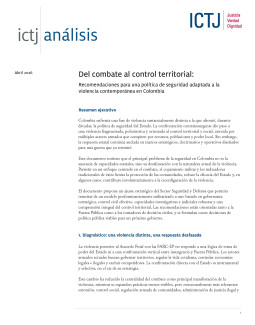
Colombia currently faces a transformed, fragmented form of violence centered on territorial and social control rather than the traditional insurgency. This briefing paper argues that state security strategies remain misaligned, relying on outdated military approaches and metrics. To a...

Image of first page of the briefing paper "From Combat to Territorial Control"

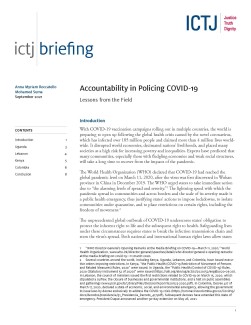
The global COVID-19 pandemic forced many countries to impose emergency measures, such as curfews and community lockdowns, to stem the spread of the virus. To enforce these measures, some societies have given regular police forces increased power to enforce the measures, while others h...

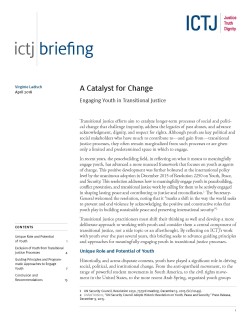
Although youth are key political and social stakeholders who have much to contribute to—and gain from—transitional justice processes, they often remain marginalized from such processes or are given only a limited and predetermined space in which to engage. In recent years, the peacebu...

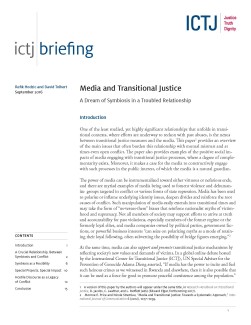
In transitional contexts, reporting does not simply present the facts, but instead shapes the parameters for interpreting divisive political issues. Coverage in such polarized contexts can mitigate or obscure the substance of transitional justice efforts to establish what happened, wh...

In this briefing paper ICTJ addresses one of the crucial points of the peace negotiations between the Government of Colombia and the Revolutionary Armed Forces of Colombia-People’s Army (FARC-EP): the possibility of providing recourse to the broadest amnesty possible and pardons as pa...

This paper weighs the possible modes and competing policy objectives of punishing FARC members for serious crimes in the context of Colombia’s ongoing peace negotiations. It argues that punishment has to occur in a way that does not damage one of the underlying objectives of the peace...

Case studies on the use of pardons in Argentina, Chile, El Salvador, Peru, and South Africa.

This study examines the development of restitution and reparations in international law and practice over the last century. It aims to provide recommendations on how restitution can best contribute to transitional justice by reviewing four case-studies: the Czech Republic, South Afric...

This paper discusses the challenges encountered during efforts to pursue justice in a number of sub-Saharan African countries in transition, including Burundi, the Democratic Republic of Congo, Ghana, Liberia, Rwanda, Sierra Leone, and South Africa. It presents a background and geneal...

This research brief provides case studies on the use of pardons in Argentina, Chile, El Salvador, Peru and South Africa following periods of mass abuse, and highlights subsequent political and civil society action to overcome impunity exacerbated by pardons and amnesties.

