






257 results

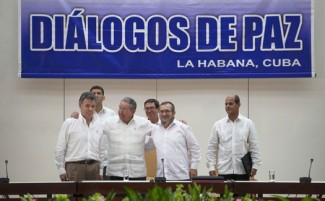
The International Center for Transitional Justice welcomes the recent agreement between the Government of Colombia and the Revolutionary Armed Forces of Colombia to create a special criminal jurisdiction as part of an integrated system of truth, justice, reparations and guarantees of non-recurrence.

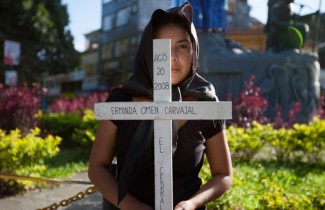
Some of the relatives’ stories start with the banging of a door at night, followed by a sudden abduction; others begin with a seemingly innocent citation to appear at a police station for a “routine procedure”. In any case, the stories always unfold in a desolate manner: as a loved one ...

For the last three years, a group of young activists gather on the night of the 5th of August at the site of Trnopolje camp, out in the open, to reenact the way prisoners spent their night and through dialogue explore alternative ways of dealing with the past.

Bosnia and Herzegovina is marking the twentieth anniversary of the Srebrenica genocide. In this Op-Ed, ICTJ's Refik Hodzic asks, can we constructively talk about reconciliation in a country still gripped by war?

ICTJ welcomes the agreement reached between the Colombian government and the Revolutionary Armed Forces of Colombia (FARC) guerrilla group to create a truth commission, after a peace agreement is signed.

In the wake of the agreement between Colombia and FARC to form a truth commission, ICTJ's Fernando Travesí and Félix Reátegui discuss the role such a body should be expected to fulfill.

In this op-ed, ICTJ Vice President Paul Seils questions the policy objectives of punishing members of FARC accused of the most serious crimes in the ongoing Colombian peace negotiations.

A new paper by the ICTJ on the peace negotiations in Colombia considers the competing goals of punishing members of the FARC who are deemed most responsible for committing serious crimes.

This paper weighs the possible modes and competing policy objectives of punishing FARC members for serious crimes in the context of Colombia’s ongoing peace negotiations. It argues that punishment has to occur in a way that does not damage one of the underlying objectives of the peace...

ICTJ, in alliance with organizations Corporación Caribe Afirmativo, Colombia Diversa and Santa María Fundación organized meetings with activists and victims of the conflict to learn more about the needs of the LGBTI community, and to consider how transitional justice measures—especially non-judicial approaches—can contribute towards protecting their rights.