206 results

Throughout 2025, ICTJ’s experts offered thoughtful analysis on conflicts and major political developments in more than 10 countries as part of the World Report newsletter. Their insightful commentaries shed light on the obstacles that victims, civil society, and their partners must navigate as they pursue sustainable peace and justice. In this edition, we look back on the past year through the Expert’s Choice column.

On International Criminal Justice Day, 2014, ICTJ joins the global celebrations marking the groundbreaking establishment of the Rome Statute in 1998, which created the International Criminal Court (ICC). To mark the day, we review five contexts where national systems proved it was possible to bring perpetrators to justice where it matters the most.

It is highly unlikely that we will see ad hoc international tribunals or elaborate hybrid courts such as the SCSL and the ECCC in the future, asserted ICTJ President David Tolbert at an expert meeting about the future of international justice in light of past experiences and progress made at the...

On October 25, the African Union (AU) and European Union officially launched their joint Initiative for Transitional Justice in Africa (ITJA) in Addis Ababa. The project will take place over a three-year period and will promote national transitional justice processes in Africa, in line with the AU Transitional Justice Policy and its roadmap. The ITJA has several unique features that, if embraced and advanced by all actors, have the potential to trailblaze a new and inspiring path to peace, justice, and sustainable development on the African continent.

The term reconciliation has long been associated with the field of transitional justice and is often presumed to be one of its goals. At the same time, reconciliation has been both controversial and vague as a concept, giving rise to different understandings and approaches. This paper...

The War Crimes Chamber of the Court of Bosnia and Herzegovina, which began its work 9 March 2005, has been the most significant national effort in Bosnia and Herzegovina to investigate and prosecute persons allegedly involved in serious violations of international law during the 1992–...

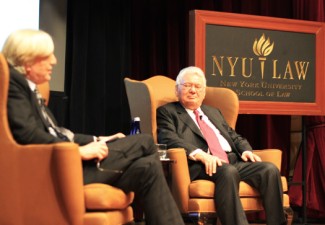
In December, ICTJ partnered with NYU School of Law and the Center for Human Rights and Global Justice to host Auschwitz survivor and Judge Thomas Buergenthal for the 7th Annual Emilio Mignone Lecture on Transitional Justice.

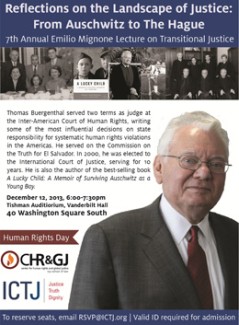
ICTJ and the Center for Human Rights and Global Justice at NYU School of Law are pleased to announce that Judge Thomas Buergenthal will be the speaker of the 7th Annual Emilio Mignone Lecture on Transitional Justice. Buergenthal is one of the world’s most distinguished jurists, whose name is synonymous with human rights and international justice. The lecture will be held on Thursday, December 12, from 6:00 to 7:30pm, in New York City.

In this op-ed, ICTJ Vice President Paul Seils discusses how education can be used to address legacies of mass violence and dictatorship.

In collaboration with the Brookings-LSE Project on Internal Displacement, ICTJ’s Research Unit examined how transitional justice can be used to address the range of injustices associated with displacement and thereby serve as part of a comprehensive approach to the resolution of displ...