



379 results

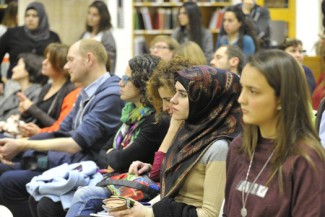
Earlier this month, the International Center for Transitional Justice (ICTJ) and its partners opened a two-week photo exhibit at the American University of Beirut’s Jafet Library, featuring vivid and often deeply personal photographs submitted for its “The War As I See It” youth photo contest. Students, professors, experts, and journalists packed into the library space lined with the 26 photographs in oversized frames.

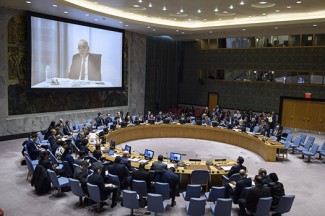
On April 4 last year, the commander of the Libyan National Army Khalifa Haftar ordered his troops to advance on Tripoli and “liberate it from terrorists.” Various stakeholders issued a multitude of statements and joint declarations after the assault, all asserting that only a political solution would resolve Libya’s crisis and threatening to hold accountable any faction that escalated the conflict. But in reality, most of the stakeholders have been playing two fields all along: the diplomatic one, in which they continuously reiterate support for political solutions and UN-led initiatives, and then the battlefield.

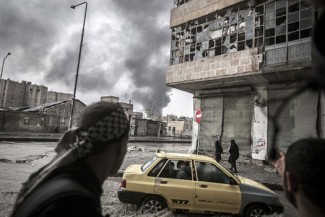
Though the future of President Bashar al-Assad’s regime remains to be seen, some are already planning for the complex aftermath of the regime’s demise. On January 26-27, Syrian activists joined ICTJ and other international experts in Istanbul for two days of discussion on possibilities for transitional justice in Syria.

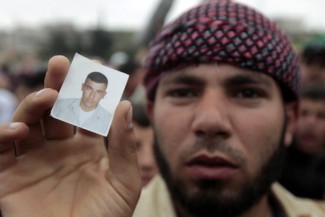
With enforced disappearances on the rise, ICTJ President David Tolbert says the path to prevention is clear: the international community must reorder its priorities and change its approach. The disproportionate attention on counterterrorism takes us further away from accountability and prevention, Tolbert writes. He urges the international community to lead the way in unequivocally censoring governments that use enforced disappearance as a political tactic — and ensuring there can be no impunity for this crime.

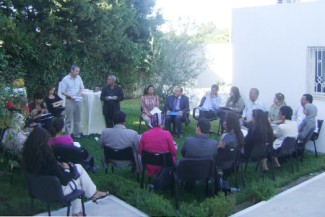
To offer assistance and international expertise to Tunisian civil society groups, ICTJ partnered with the Office of the High Commissioner for Human Rights (OHCHR) for a training on public engagement in truth seeking processes. Titled “The Role of Civil Society in Truth Commissions: Participation and Advocacy for Victims in Tunisia,” the training offered around 65 participants the opportunity to examine the role of truth commissions in contexts of transitional justice, and to assess future engagement of their organizations in Tunisia’s proposed truth commission.

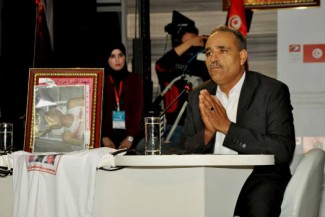
On December 17th, six years to the day after Mohamed Bouazizi set fire to himself and sparked the “Jasmine Revolution,” Tunisia’s Truth and Dignity Commission heard public testimony about events that unfolded during the revolution and the abuses of the regime it overthrew. Read victims' moving testimony about state violence, torture, corruption and marginalization as the country continues to grapple with its painful past.

As the number of victims of violence against demonstrators in Syria, Yemen, Bahrain and elsewhere in the region rises, a question emerges for the government of Bashar al-Assad of Syria, but also those of Ali Abdullah Saleh of Yemen, Hamad bin Isa al-Khalifah of Bahrain and the vacillating international community: Can impunity for such crimes be permitted in this day and age?

David Tolbert, President of International Center of Transitional Justice: "I join many others in giving a final salute to Nino Cassese. He was man of extraordinary energy, singular determination and extraordinary intellectual talents but at the same time was an unassuming man, with a ready smile, an engaging anecdote and plenty of self-deprecation. Nino was a driving force behind the field of international criminal justice, not only through his leadership of both the International Criminal Tribunal for the former Yugoslavia (ICTY) and the Special Tribunal for Lebanon (STL) but through his unstinting writing and advocating on this most crucial of subjects."

For over a month now, Lebanese people have been in the streets peacefully calling for an end to corruption, economic disenfranchisement, and government mismanagement, calling instead for accountability and reform of the systems that have allowed these things to occur. The protests are historic for several reasons: their scope and magnitude, as well as the way they have unified a country that has for so long had division baked into nearly every aspect of life, down to its system of governance.