



379 results

The start of 2022 was marked by two important victories in the fight for justice and redress for victims of human rights violations in Syria. The first was the sentencing of Anwar Raslan, a former colonel in the Syrian intelligence service, to life in prison by the Higher Regional Court in Koblenz...

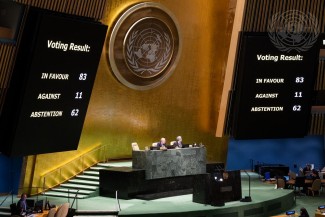
On June 29, 2023, the United Nations General Assembly adopted a resolution creating a new independent institution on the missing in the Syria Arab Republic. Eighty-three member states voted in favor, 11 voted against, and 62 abstained. ICTJ welcomes the resolution, which represents a momentary reprieve in Syria’s otherwise bleak justice landscape. This vote represents a critical step forward in supporting all those who seek answers about the fate and whereabouts of their loved ones and who suffer daily from the indignities and grave hardships that ensue when a loved one goes missing.

Beirut, June 23, 2020 — Almost a year and a half after passing Law 105 for the missing and disappeared, the Lebanese government has finally appointed the members of the National Commission for the Missing and Forcibly Disappeared. ICTJ welcomes this action, which is another step closer to uncovering the fate of thousands of victims. However, the appointment of the commissioners will be meaningless, unless the government demonstrates greater commitment to addressing the families’ right to the truth and takes the necessary action to create a commission that is credible and effective.

On Thursday, January 13, 2022, the Higher Regional Court in Koblenz, Germany, convicted Anwar Raslan, a senior official in the Syrian government, for crimes against humanity. The landmark trial, the first ever to prosecute a member of Bashar al-Assad’s regime for such crimes, highlights a crucial component without which Raslan would never have been convicted: the role of victims in achieving justice.

ICTJ is more than two decades old. At the time it was established, many of those who contributed to transitions in Argentina, Chile, Guatemala, South Africa, and the former Yugoslavia saw the value of a specialized organization that could draw from diverse national experiences to prov...

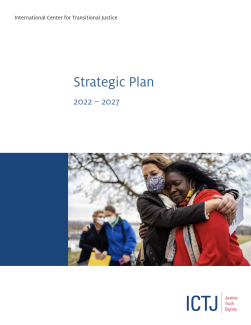
The cover of a report with the text, "2022-2027, Strategic Plan," with an image of people embracing underneath.

Transitional justice measures should serve to rectify, not replicate, patterns of discrimination against women. These mechanisms can challenge structural causes of gender inequality, by publicly acknowledging the factors that made such abuse possible. In the Middle East and North Africa, like in many other contexts, it is a challenge to ensure transitional justice measures do not further entrench the invisibility of gender-based abuses. As different countries consider the ways to confront the legacies of past abuses, ICTJ works with women’s groups across the region to build their capacity to engage in discussions around transitional justice and gender.

This article examines and evaluates the Iraq Tribunal's Dujail Trial. The trial marks the beginning of a longer accountability process in the country and can potentially make a lasting contribution to transitional justice. This study assesses the fairness and effectiveness of the tria...

As the international community considers its response to the surging violence in Syria, those responsible for gross human rights violations in the country should be held to account, said the International Center for Transitional Justice (ICTJ) today.

Across Syria today, we continue to witness human rights violations and abuses that run counter to the very principles upon which the revolution was built. In particular, recent violence in the coast and Sweida has deepened the sense of fear and mistrust already felt by many communities. Meanwhile, Syria's new transitional justice commissions have been working hard to lay the foundations of their mandates. Now, at this critical juncture, they must show that they are ready to lead and first and foremost to serve victims.

During the Ben Ali dictatorship in Tunisia, Najet Gabsi, an educator pursuing a diploma in law, was imprisoned for six months for her political activities. Through her participation in the "Voices of Memory" art exhibition, she was able to reignite her passion for activism and articulate the harms she endured at the hand of the regime.