




229 results

As the work of Tunisia's Truth and Dignity Commission winds down, ICTJ's Salwa El Gantri and Kelli Muddell discuss some of the challenges and successes of its work and their vision for transparent, participatory processes to advance Tunisia’s transitional justice mandate in the short and long term.

Many countries have endured a violent past or a dictatorship that left behind a trail of human rights violations. During transitions to peaceful societies or democracies, there is a need to address that painful past to ensure that the violations do not recur in future. While some countries have made or are making laudable efforts to deal with the atrocities of the past, others like Kenya are regrettably still at the phase of wishing the painful past away.

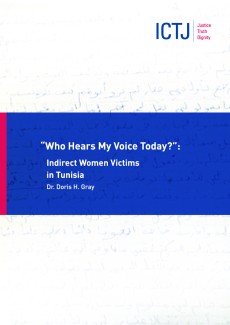
This report focuses on “indirect victims” of human rights violations in Tunisia, namely, the wives, sisters, and children of political prisoners in Tunisia, who suffered discrimination, social exclusion, police violence, and harassment during the dictatorship. Presenting documentation...

Kenyan media house Africa Uncensored has teamed up with the International Center for Transitional Justice (ICTJ) on a documentary that explores the Bulla Karatasi massacre that took place in the northern region of Garissa, Kenya, and its impact on communities in the North. The documentary will advance ICTJ’s efforts to partner with civil society on community-state dialogue initiatives, engage stakeholders around political and constitutional reforms stemming from the TJRC’s recommendations, and achieve redress for the legacy of state violence in Garissa and other communities in Northern Kenya.

From October 1 to October 5, 2018, ICTJ hosted its eleventh intensive course on transitional justice in collaboration with the International Peace Center for in Barcelona. Participants included leaders in their respective fields, including human rights law, community justice and legal services, peacebuilding, education, and humanitarian affairs.

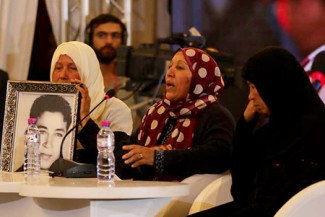
Tunis, September 24, 2018—The International Center for Transitional Justice and the University of Birmingham launched Voices of Memory, an interactive exhibition inspired by a collective of nine Tunisian women from across the country and from different generations. The exhibition is the first collective testimonial of Tunisian women who experienced human rights abuses under the Ben Ali regime.

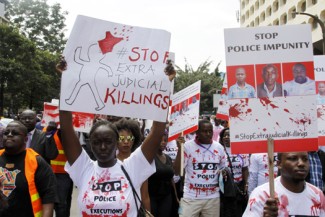
ICTJ's Virginie Ladisch spoke with Heythem Guesmi, a young Tunisian activist who is fighting systemic oppression, economic exclusion, and impunity that persist despite the Revolution’s initial success, and Thenjiwe McHarris, a young organizer working with Black Lives Matter in the United States—a movement whose urgency also stems from historic marginalization leading to widespread impunity and systematic failures in law enforcement.

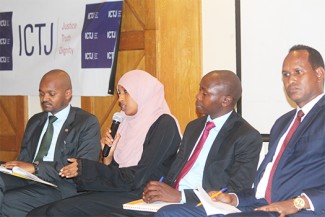
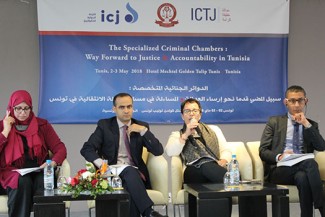
TUNIS—ICTJ hosted a conference on May 2 and 3 to address the current challenges facing Tunisia’s Specialized Criminal Chambers (SCC) as it proceeds to adjudicate cases of serious human rights violations committed under the former regime. The 90 guests who attended included members of Tunisia’s Truth...

This briefing paper focuses on the role of victims of human rights violations in criminal proceedings. This paper will provide examples of recent developments in the advancement of victim participation in criminal proceedings in international criminal law and domestic jurisdictions.&n...

Pursuing justice in a transitional context may take the form of multiple measures and goes beyond the pursuit of criminal prosecutions. Tunisia’s Basic Law on Transitional Law, adopted in December 2013, is a case in point. Despite its flaws, the the law introduced a fairly c...