1541 results

Following field research in late 2009 and a 2010 workshop in Kinshasa, ICTJ produced a report in French on the challenges of enforcing court-ordered reparations. This briefing paper outlines and summarizes the challenges and recommendations discussed in the report. It also proposes ad...

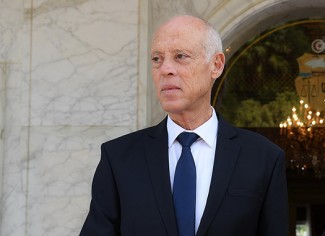
On February 6, 2022, President Kaies Saied announced that he would dissolve Tunisia’s Supreme Judicial Council. While his supporters welcomed the declaration with satisfaction, many more across broad segments of society greeted it with outrage and resentment. That the president made this unilateral announcement on the premises of the Ministry of Interior—responsible for public security—stung all the more, as if to send a message that he would not hesitate to use executive power to counter perceived disobedience, judicial or otherwise.

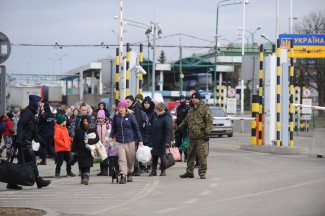
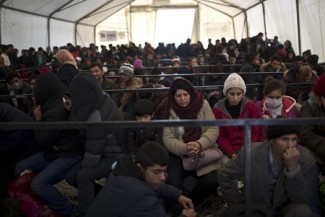
In the latest round of negotiations between Ukraine and Russia, the Turkish president called on both delegations to act responsibly and agree to a ceasefire. He reminded them of their historical mission to achieve a "just peace." While we may not know how and when this conflict will end, we already know some of what Ukrainian society will be grappling with in the near future. Significant portions of country’s civilian infrastructure have been destroyed. More than 4 million Ukrainians are now refugees; another 10 million are internally displaced; and a rising but still undetermined number have been killed, are missing, or are wounded. The real question is what does a just peace mean for Ukrainians.

This paper considers the UN-sponsored regime established to respond to the crimes committed in East Timor during the Indonesian occupation between 1975 and 1999. The story of the quest for justice in East Timor perhaps can be summed up as one involving good intentions that were not ba...

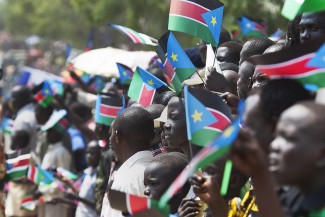
South Sudan’s transition to democratic governance through a highly anticipated, first-ever post-independence general election has to wait once again for another two years. Despite this latest extension, the country has achieved notable milestones in its transitional justice process.

View the live broadcast of tonight's Annual Emilio Mignone Lecture on Transitional Justice, from 6:00pm–7:40pm. Try Ustream's free video streaming desktop app

This year’s Annual Emilio Mignone Lecture on Transitional Justice, coordinated by ICTJ and the Center for Human Rights and Global Justice at the NYU School of Law, focused on the intersection between transitional justice and international development.

Colombia continues to endure a complex conflict spanning more than four decades that has resulted in almost 400,000 registered victims and has displaced more than three million people. In a podcast with ICTJ’s vice president Paul Seils, we explore the concepts of prioritization and selection of cases and their relevance to Colombia's Justice and Peace process.

It has been nearly seven years since the passage of the Justice and Peace Law (JPL) in Colombia. The process continues today amidst controversies and important reflections on the direction it should take. What progress has been made and what are the shortcomings of how the law has been implemented?

ICTJ convenes a high-level conference in Abidjan to discuss the progress in investigating and prosecuting serious crimes committed in Cote d’Ivoire during the 2010 post-election violence.

A Haitian court’s decision to drop charges of crimes against humanity against former president Jean-Claude Duvalier is a blow to the victims of his brutal dictatorship and sends a disturbing signal that the country cannot fulfill its basic legal obligations, ICTJ said today.

The world has turned its eyes to Guatemala, where the trial of retired generals Efraín Ríos Montt and José Mauricio Rodríguez Sánchez is drawing to a dramatic close. With a verdict expected soon, ICTJ spoke with Francisco Soto, executive director of the Center for Legal Action on Human Rights in Guatemala (CALDH). In this Q&A, Mr. Soto describes how civil society in Guatemala has been a crucial force in the long struggle for justice, and reflects on the historic significance of this trial, for both Guatemala and the world.

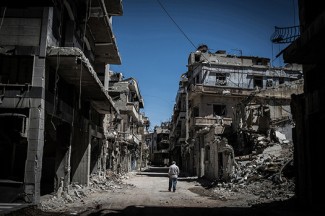
When the Syrian people took to the streets in March 2011, nobody could have predicted that the ensuing crisis would become the largest international calamity in recent history. Syrians’ calls for freedom and justice, which rode the wave of revolutions in neighboring countries, have be...

By looking at the documentation efforts of Syrian civil society organizations, this paper challenges the notion that criminal prosecution is the sole avenue of justice available for alleged crimes in Syria. Documentation could be used for important other avenues of justice, such as ac...

As the world marks August 30, the International Day of the Disappeared, we are reminded that forced disappearances and transitional justice share a common history. Indeed, processes working in concert that came to form the field of transitional justice were born from the search for truth and justice about the disappeared.

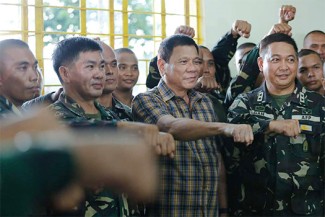
On June 25, President of the Philippines Rodrigo Duterte publicly proposed arming civilian supporters in his war on drugs. His statement comes barely a week after the International Criminal Court’s (ICC) outgoing prosecutor, Fatou Bensouda, announced her request to open an investigation into crimes against humanity related the Philippines’ war on drugs. This step has been long-awaited by victims of the drug war. Nonetheless, the ICC case should be part of a larger, more strategic fight for justice in which the needs, safety, and future of the predominantly poor families victimized by the drug war are central and just as important as naming, shaming, and prosecuting the perpetrators and abettors of these crimes.

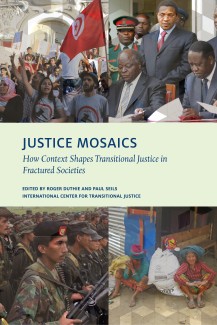
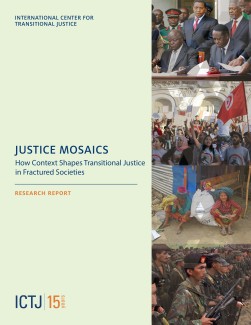
What hope is there for justice for victims of atrocities in profoundly fractured societies, where systems of government have broken down and social and political divisions run deep? What is the role of transitional justice in forging peace in countries like Colombia, after decades of ...

This report presents the main findings of a multiyear research project conducted by the International Center for Transitional Justice on the challenges and opportunities of responding to serious and massive human rights violations in different contexts. The project commissioned 21 stu...

The European Union has an extensive commitment to peacebuilding. This includes the whole range of relevant EU activities, from facilitating peace agreements and crisis management under the Common Foreign and Security Policy (CFSP), to short, medium, and long-term peacebuilding program...

Vetting—the process by which abusive or corrupt employees are excluded from public office—is often practiced in post-conflict societies, yet remains one of the least studied aspects of transitional justice. In a co-publication of the Social Science Research Council (SSRC) and the...

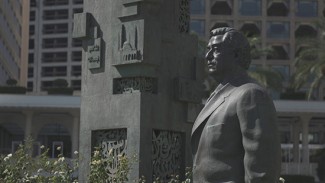
On August 18, nearly two decades after Lebanon’s former Prime Minister Rafik Hariri was brutally assassinated in a car bombing, the Special Tribunal for Lebanon delivered a long-awaited conviction. The judgment found Salim Ayyash guilty of conspiracy to commit a terrorist act, committing a terrorist act, the intentional homicide of Hariri and 21 others, and attempted homicide of the 226 injured. However, the tribunal did not find enough evidence that the three other defendants were aware in advance of the conspiracy and thus acquitted them of all charges. This split verdict makes an uncertain situation in Lebanon even more tenuous.

In a new briefing paper, ICTJ's Paul Seils and Roger Duthie examine what steps the international community can take during a crisis to support democracy and accountability.

A new ICTJ paper released today challenges the notion that criminal prosecution is the sole use for documentation of violations in Syria. Titled "Justice for Syrian Victims Beyond Trials", it urges the international community, human rights groups and Syrian civil society organizations to use the tools at their disposal to pursue overlooked avenues towards justice. These include the search for the truth, public acknowledgement of violations, and laying the foundation for future truth-seeking and truth-telling processes or reparations process.

Today, we are facing a global public health crisis of unprecedented proportions. Only time will tell the devastating toll that COVID-19 will exact on human life. The breakneck speed at which the virus is spreading does not give us reason for optimism in the near future. We at ICTJ fully grasp the gravity of the situation, and we take our responsibility for the health and safety of our staff, partners, and communities where we work seriously.

In October 2008, fighting erupted in the North Kivu province in eastern Democratic Republic of Congo (DRC) between rebel troops of Laurent Nkunda's Congrès National pour la Défense du Peuple (CNDP) movement, local militia groups, and troops of the Forces Armées de la République Démocr...