



1530 results

The International Center for Transitional Justice (ICTJ) and the United Nations Development Programme, with the support from the governments of Denmark and South Africa, held a retreat on Supporting Complementarity at the National Level: An Integrated Approach to the Rule of Law, at G...

As ICTJ co-hosts a discussion on complementarity on the margins of the Assembly of State Parties (ASP) of the International Criminal Court (ICC), the principle of ensuring accountability for serious crimes has seen a major breakthrough at a recent high-level meeting at Greentree. The meeting brought together international justice actors, development practitioners, UN representatives, and national rule of law actors to discuss the practical implementation of complementarity and how to strengthen domestic systems seeking to investigate serious crimes.

NEW YORK, Dec. 14, 2011—ICTJ welcomes the election of Fatou Bensouda of Gambia as the next prosecutor of the International Criminal Court (ICC). Ms. Bensouda was unanimously elected December 12 by the Assembly of States Parties (ASP) during its 10th session in New York City, and will be the court's second prosecutor, commencing in June 2012.

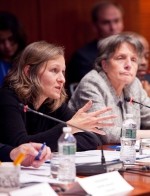
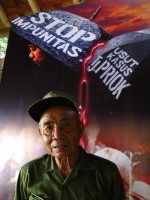
A report released today by ICTJ, together with the Indonesian Association for Families of the Disappeared (IKOHI) and the Coalition for Justice and Truth (KKPK), calls on the government to fulfill its obligations to provide reparations to thousands of victims of gross human rights violations.

JAKARTA, Dec. 12, 2011—A report released today by the International Center for Transitional Justice (ICTJ), together with the Indonesian Association for Families of the Disappeared (IKOHI) and the Coalition for Justice and Truth (KKPK), calls on the government of Indonesia to fulfill its obligation to provide reparations to thousands of victims of gross violations of human rights.

Thirteen years after the fall of Soeharto, victims in Indonesia continue to suffer from the negative effects of gross human rights violations and from ongoing discrimination. Although efforts by the president and the National Human Rights Commission (Komnas HAM) to create a reparation...

During peace negotiations, there is often a belief that providing amnesties for certain crimes will help promote national reconciliation. Nepal's Truth and Reconciliation Commission (TRC) Bill currently contains provisions on both amnesty and reconciliation. However, the Bill itself i...

Indonesia has initiated transitional justice mechanisms to address human rights abuses that occurred during and after the New Order regime, but insufficient political will has rendered these efforts inadequate in achieving justice and reconciliation for victims.

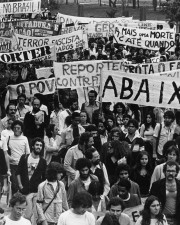
Brazil’s recent decision to examine the abuses of the military dictatorship from several decades ago could change the face of democracy at home, making it more genuine and transparent. At the same time it could have a wider impact, allowing Brazil to take a decisive stand on human rights regionally and internationally.

ICTJ spoke with Pablo Parenti about the trial that just concluded which investigated human rights violations and crimes against humanity that occurred at the Naval Mechanics School (ESMA), used as a detention and torture center during the Argentine dictatorship.

ICTJ interview with Pablo Parenti, of the Attorney General’s Unit for coordination and monitoring cases involving violations of human rights during the Argentine dictatorship.

Whether the government can lawfully rely on Exemption 7(F) of the Freedom of Information Act, 5 U.S.C. § 552(b)(7)(F), to withhold photographs depicting the abuse of prisoners held in U.S. custody without identifying with reasonable specificity any individuals who could reasonably be ...

Research Brief: Selected examples of Defence, Intelligence and Justice Investigative Reports into detention and interrogation practices.

Examples of pardons in international jurisprudence, including Inter-American Court and Commission, European Court of Human Rights, UN Treaty Bodies, and the African Commission on Human and Peoples’ Rights.

Case studies on the use of pardons in Argentina, Chile, El Salvador, Peru, and South Africa.

Recent speculation indicates that U.S. President George W. Bush may grant pardons to administration officials and members of the military who might face prosecution for authorizing, ordering, endorsing, justifying or committing acts pursuant to the “war on terror.” While a pardon appl...

View the live broadcast of tonight's panel discussion with Richard Goldstone, David Tolbert, Hassan Jallow and Diane Orentlicher from 6:30pm–8:30pm.

ICTJ and the Center for Memory, Peace and Reconciliation of Colombia are organizing an event on Memory: Public Policy for Transformation. Dialogue at the conference will serve as the basis for providing recommendations to the process of creating the Center for Historical Memory and designing public memory policy in the country.

This year marks the 20th anniversary of the publication of Children of Cain, the first book by writer and journalist Tina Rosenberg. ICTJ spoke with Rosenberg about how political violence has evolved in Latin America over the past 20 years, and the continuing need for accountability for past atrocities.

This year marks the 20th anniversary of the publication of Children of Cain, the first book by writer and journalist Tina Rosenberg. ICTJ spoke with Rosenberg about how political violence has evolved in Latin America over the past 20 years, and the continuing need for accountability for past atrocities.

This report is the fourth in a series monitoring the implementation of a collective reparations program in Peru since 2007, by ICTJ and the Association for Human Rights in Peru (APRODEH). The publication examines the effects of this reparations program through interviews with the bene...

As part of an ongoing partnership between ICTJ’s Children and Youth Program and the Truth and Reconciliation Commission (TRC) of Canada, youth from throughout Canada attended the third national TRC hearings to document the work of the commission. This weekend they are attending a retreat to finalize their radio segments and short films to raise awareness about what they have learned.

This year’s Annual Emilio Mignone Lecture on Transitional Justice, coordinated by ICTJ and the Center for Human Rights and Global Justice at the NYU School of Law, focused on the intersection between transitional justice and international development.

JAKARTA, Nov. 15, 2011—Experts and stakeholders from Cambodia, the Philippines, Bangladesh, Indonesia, Burma, Timor-Leste, Thailand, and Nepal, along with international experts are gathering in Jakarta’s Hotel Atlet from November 15–16 to discuss the need for progress on prosecuting serious crimes in Asia.