1541 results

In January 2022, ICTJ launched the Wide Awake Art Contest, an open call event inviting Lebanese and Tunisian artists as well as artists living in Lebanon or Tunisia to explore the theme “the Sound of Dissent.” The contest spotlights the creative works by those who are documenting and me...

In Afghanistan, community theater has begun to be used as a method of transitional justice to give victims a voice and create positive impulses for peacebuilding. According to a new briefing paper released by ICTJ, through theater, victims are able to create a “safe space” to discuss ...

Money alone cannot compensate sexual violence committed on a massive scale, particularly when such crimes are accompanied by other forms of violations affecting entire communities. ICTJ's Cristián Correa examines how rehabilitation, education, and acknowledgement can bring victims closer to full restitution for their suffering.

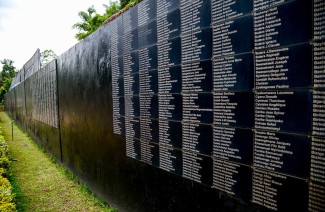
Thirty years after the 1994 genocide against the Tutsi in Rwanda, painful memories of those gruesome 100 days, during which almost one million Rwandan citizens lost their lives, still haunt the people of Rwanda, the rest of Africa, and the world. It is a solemn occasion to remember and honor the victims and survivors of the genocide and to acknowledge the tremendous strength and resilience they have shown in the wake of unspeakable tragedy. However, it is also a time for candid introspection on the African continent, and around the world, about the policies and mechanisms in place to prevent such atrocities.

In the wake of Charlottesville, some took to Twitter to distance the United States from the white supremacist march using #ThisIsNotUs. But this is us, writes Virginie Ladisch, and white Americans have an obligation to educate themselves about the history and persistence of white supremacy in their country.

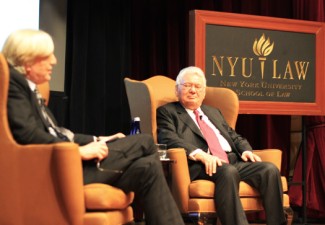
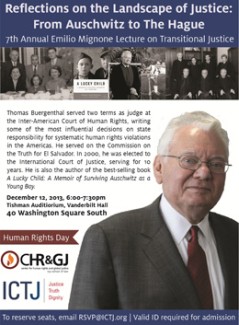
In December, ICTJ partnered with NYU School of Law and the Center for Human Rights and Global Justice to host Auschwitz survivor and Judge Thomas Buergenthal for the 7th Annual Emilio Mignone Lecture on Transitional Justice.

ICTJ and the Center for Human Rights and Global Justice at NYU School of Law are pleased to announce that Judge Thomas Buergenthal will be the speaker of the 7th Annual Emilio Mignone Lecture on Transitional Justice. Buergenthal is one of the world’s most distinguished jurists, whose name is synonymous with human rights and international justice. The lecture will be held on Thursday, December 12, from 6:00 to 7:30pm, in New York City.

Situation brief on the International Criminal Court's prosecution against Thomas Lubanga, the former leader of the Union des Patriotes Congolais (UPC) who has been charged with genocide and crimes against humanity. Due to problems with the prosecutor's proposed use of evidence, the tr...

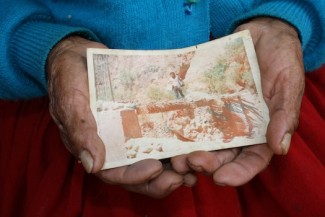
On the International Day of the Disappeared, ICTJ Vice President Paul Seils argues that addressing the legacy of forced disappearances is both a moral imperative and a pragmatic necessity.

This study aims to communicate the perspectives, expectations, and needs of South Sudanese displaced persons to relevant policymakers and thereby inform the ongoing transitional justice efforts emanating from South Sudan’s 2018 revitalized peace agreement. It also provides lessons lea...

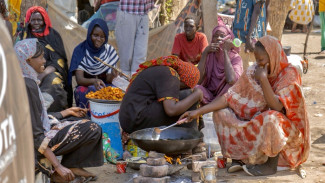
several women in colorful dresses crouch around an open fire pit, cooking food in a large pan.

ICTJ releases of three short documentaries about the work of civil society organizations in Colombia intent on revealing the truth about the impact of the country's armed conflict.

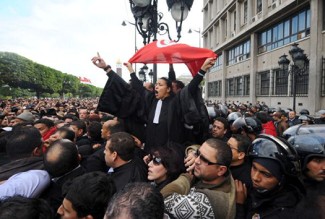
Three years after Tunisia's revolution, victims in the south of the country are still facing severe economic and social marginalization. In recent workshops with ICTJ, they explain why collective reparations and development are both central parts of their vision of justice.

Marking three years since Tunisia's revolution, ICTJ President David Tolbert argues that transitional justice developments in the country are not only worthy of attention, but serve as useful markers for transitions in the region and beyond.

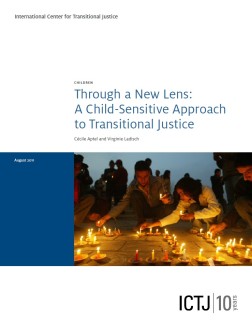
“Through a New Lens: A Child-Sensitive Approach to Transitional Justice” analyzes experiences of four countries—Liberia, Democratic Republic of Congo (DRC), Colombia and Nepal—and identifies some key lessons on children’s participation in transitional justice measures. Authored by Céc...

With the conclusion of the mandate of the Truth and Dignity Commission (TDC), ICTJ looks back on the major events in Tunisia stemming from the Arab Spring that led to the TDC's creation, which involved the participation of a broad spectrum of people representing the country's multifaith, politically divided, and economically stratified society.

This year marks the 20th anniversary of the publication of Children of Cain, the first book by writer and journalist Tina Rosenberg. ICTJ spoke with Rosenberg about how political violence has evolved in Latin America over the past 20 years, and the continuing need for accountability for past atrocities.

Seeking justice for victims of enforced disappearance is crucial to building peace and preventing recurrence of violence in societies emerging from conflict, ICTJ President David Tolbert told members of the United Nations Security Council and other diplomats last week.

This documentary captures the inconceivable story of the siege of Colombia’s Palace of Justice by M-19 guerilla movement in 1985.

This award-winning short, animated documentary follows a young mother of two whose husband was detained and disappeared by security forces in Syria some years ago. The film takes the viewer on her journey as a refugee searching for safety in Berlin and depicts the daily struggles she en...

This short animated documentary follows a young mother of two whose husband was detained and disappeared by security forces in Syria some years ago. The film takes the viewer on her journey as a refugee searching for safety in Berlin and depicts the daily struggles she encounters once s...

Indonesia and Timor-Leste created the Commission for Truth and Friendship (CTF) bilaterally in 2005. The commission has not yet delivered substantive transitional-justice benefits, and its public hearings have seriously compromised the goals of truth and resconciliation. This report i...

In the United States, reparations efforts at the municipal level have demonstrated momentum, innovation, and progress in recent years. However, for many of these initiatives, how to make them sustainable and impactful remains a challenge. Drawing on domestic and international experien...

People seated in a circle speak and laugh

Contemporary societies find it very difficult to bring about qualitative and systemic changes. This affects development and transitional justice processes in similar ways, for both practices seek to bring about precisely such changes; the shared challenge is a link between the two fie...

International policymakers recognize that transitional justice is an important component of the 2030 Agenda for Sustainable Development, especially in countries affected by systemic violence, repression, and marginalization. Yet responses to massive human right violations often remain...

Cover image of the report Toward Victim-Centered Change: Integrating Transitional Justice into Sustainable Peace and Development. It features several black lines that lean slightly to the right. A single yellow at the far right stands straight.

This briefing paper focuses on establishing a credible approach to accountability and human rights in a post-conflict Syria. Looking ahead to an eventual resolution to the war, it recognizes that Syrian authorities and civil society, as well as the international community, will have t...