








1530 results

The International Center for Transitional Justice (ICTJ), in partnership with the Barcelona International Peace Resource Center (BIPRC), is pleased to announce its third Intensive Course on Truth-Seeking. Our 2011 course will focus on the relationship between peacebuilding and transit...

ICTJ hosted its third Intensive Course, Truth-seeking and the Challenge of Sustainable Peace, on September 26–30. Based on concrete field experience, the participants explored the relationship between truth-seeking and peace in societies that have experienced or are still experiencing armed conflict.

Join ICTJ as we co-host a delegation of RECOM’s leaders at two events in New York on November 14 and 15. They will share their experience campaigning for truth in the Western Balkans, present the draft mandate submitted to the presidents of the region, and discuss a successful public campaign that has gathered over 500,000 signatures in support of the commission.

Refugees and internally displaced persons (IDPs) have often been directly affected by the crimes truth commissions seek to expose, and have a major stake in the success of transitional justice processes, which can shape the stability of post-conflict communities as well as the prospec...

An internal armed conflict involving the government, leftist guerrillas, and a variety of paramilitary groups and criminal bands has endured in Colombia for the last 60 years, generating massive levels of displacement. A comprehensive truth commission that investigates major human rig...

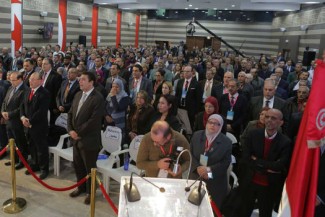
The international conference on transitional justice 'Addressing the Past, Building the Future: Justice in Times of Transition' concluded today in Tunis, following two days of discussions on justice models and measures implemented in transitions. View the conference blog The conference explored...

On January 14, Tunisia's Truth and Dignity Commission will resume public hearings. Salwa El Gantri outlines how ICTJ has worked with the TDC and civil society to amplify victims' voices.

As the Tunisian government takes firm steps to investigate human rights abuses committed since 1955, including under the Ben-Ali regime, ICTJ calls for care and attention in appointing members to the upcoming Truth and Dignity Commission.

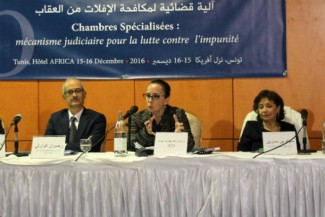
In Tunisia, efforts to seek criminal accountability have been characterized by an absence of strategy and the lack of political will. An ICTJ conference sought to address these issues and ease the confusion and political gridlock surrounding the Specialized Judicial Chambers.

As Tunisia concludes its final deliberations on the new constitution, transitional justice issues such as reparations for victims, truth about the past and the rights of women have been central to the legislative debates. Over the past month, ICTJ’s leading experts have been engaged with stakeholders on the ground on a variety of issues under deliberation, including truth-seeking, reparations, gender justice, and the role of children and youth.

In Tunisia, public hearings have fundamentally changed public dialogue about the past. The Truth and Dignity Commission will hold special session scheduled to coincide with the International Day for the Right to the Truth on March 24th. Watch live here:

The National Conference to Launch a Dialogue on Transitional Justice in Tunisia was held on Saturday, April 14 in Tunis, initiating a process which should result in the adoption of a comprehensive law on transitional justice by the country’s National Constituent Assembly. ICTJ president David Tolbert delivered a keynote address.

As Tunisia’s Truth and Dignity Commission (TDC) prepares to hear the testimonies of thousands of citizens, ICTJ is assisting women’s groups in ensuring that their voices are heard in the process.

The Tunisian government reintroduced a bill that, if passed, would grant a path for reconciliation to corrupt business people and Ben Ali-era officials. They claim it will stimulate the economy, but economics professor Dr. Abdeljelil Bédoui explains why this law is not the solution.

In this op-ed, ICTJ's President David Tolbert expresses concern about the new "Reconciliation Bill" proposed by the Tunisian government, which would grant amnesty to corrupt business people and Ben Ali-era officials in the guise of "reconciliation." "Massive corruption and violent human rights violations are mutually reinforcing, and unless this linkage is exposed and broken, it can lead to mutually reinforcing impunity," writes Tolbert.

In this interview, Judge Walid Melki explains how Tunisia's Specialized Judicial Chambers will investigate and prosecute serious human rights violations.

Hailed as one of the only success stories to emerge out of the Arab Spring, Tunisia is now facing a significant challenge to its democratic progress. On July 25, Tunisia’s president, Kais Saied, enacted Article 80 of the Tunisia Constitution giving him emergency powers to protect the country from imminent threats. He then used these powers to suspend parliament, lift parliamentary immunity, and fire the prime minister as well as the ministers of justice and defense.

This briefing paper details and analyzes the progress made so far in Tunisia to implement its historic Transitional Justice Law, with a particular focus on the Truth and Dignity Commission, created one year ago.

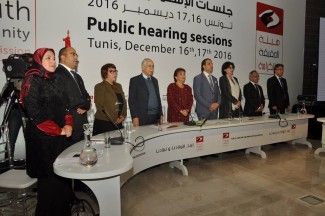
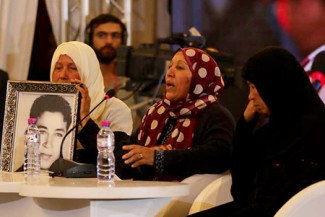
Following two days of historic public testimony last month, Tunisia's Truth and Dignity Commission's second set of public hearings continue. Watch the livesteam below and follow us on twitter at @theICTJ for live coverage.

As the work of Tunisia's Truth and Dignity Commission winds down, ICTJ's Salwa El Gantri and Kelli Muddell discuss some of the challenges and successes of its work and their vision for transparent, participatory processes to advance Tunisia’s transitional justice mandate in the short and long term.

ICTJ joins groups calling for an anti-terrorism approach that respects citizens' rights in Tunisia. “Institutional reform can be a strong tool to prevent recurrence of human rights abuses and build a strong and credible democracy in Tunisia," said Salwa El Gantri, ICTJ Head of Office in Tunisia. "The current transitional justice process aims to shed light on similar violations that took place under the dictatorship, and we don’t want them to be committed again under the ‘fight against terrorism’ slogan.”

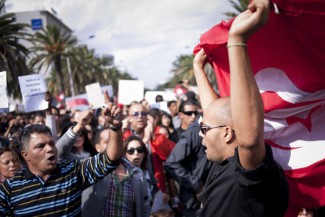
Tunisian activists have taken to the streets this month to protest the proposed Economic Reconciliation Law recently revived in parliament. If approved, the bill would offer a path for corrupt Ben Ali-era officials and business people to legalize their stolen assets and secure a form of amnesty.

Tunisia has faced many challenges since the launch of the National Dialogue on Transitional Justice two years ago, including political assassinations that rocked the process as well as a number of political blockages. Yet the Tunisian people came through a complex and challenging process and achieved important results — results that can provide the foundation to confront a long legacy of human rights abuses and pave the way towards a democratic transition built on the rule of law and trust between citizens and the state.

Nepal’s new local government structure – comprised of districts, municipalities, sub-municipalities, and wards formed within the new federal system under the 2015 Constitution – offers the possibility of some individualized redress for victims at the community-level. This article by Elena Naughton was published in the Kathmandu Post on May 6, 2018.

For more than 20 years, the Amnesty Law has hindered El Salvador from pursuing accountability for perpetrators of serious crimes committed against civilians during the civil war fought between the government and leftist insurgents in the 1980's. However, this may change in very near future. On September 20, the Constitutional Court admitted a petition claiming that the Amnesty Law passed in March 1993 –which shielded perpetrators of serious crimes committed during the 12-year civil war– is unconstitutional.