





1530 results

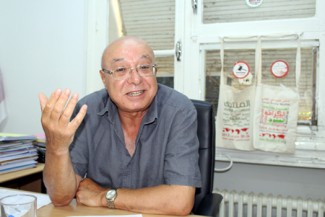
Building for the Future. An interview with Hanny Megally, ICTJ Middle East and North Africa Program Director.

Transitions focuses on engaging new generations and the children's project. Virginie Ladisch, ICTJ Program Associate for the Children's Project, discusses children and justice efforts around the world.

Making Connections. An interview with Pablo de Greiff, ICTJ Research Unit Director.

Transitions focuses on new directions and challenges for the organization. Kofi Appenteng, ICTJ Board Chair, discusses his background and his new role as Board Chair.

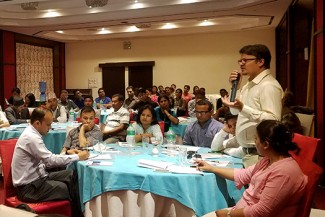
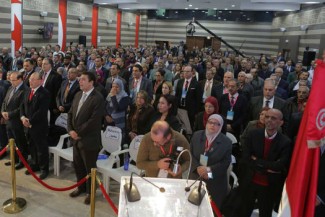
TUNIS, Apr. 14, 2011—The international conference on transitional justice, Addressing the Past, Building the Future, opened this morning in Tunis with more than 150 participants from Tunisia and other countries of the Middle East and North Africa. In sessions dealing with transitional justice...

On March 2 and 3, 2020, transitional justice and anti-corruption policymakers, experts, and activists from the Gambia, Kenya, South Africa, Armenia, and Tunisia met in Tunis for a two-day conference to share solutions to a common problem: How can countries eme...

The National Accord, negotiated in February 2008 by the Panel of Eminent African Personalities led by Kofi Annan, ended the months of violence that followed Kenya’s 2007 presidential election. The transitional justice mechanisms established by the accord have created an opportunity to...

The recent re-election of Colombia’s president, Juan Manuel Santos, brings hope to a country seeking to end a half-century of conflict. But, as with so many peace processes, finding a balance between creating a stable accord and acknowledging the terrible injustices that occurred during the conflict can be difficult to achieve.

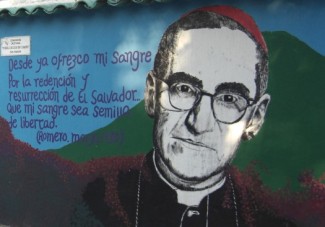
On the International Day for the Right to the Truth and 35 years after the assassination of Archbishop Oscar Romero, ICTJ Vice President Paul Seils explains why the pursuit of the truth is not a second-best option in the absence of other remedies: it is the most basic requirement of taking seriously the dignity of victims.

As the first truth commission in the region, Morocco’s Equity and Reconciliation Commission sought to address the legacy of more than 40 years of repression and human rights violations known as the “Years of Lead.” The commission was part of a gradual process of dealing with the past,...

A range of transitional justice measures should be considered in addressing the Kenyan crisis, including holding key perpetrators to account in a court of law, providing reparations for victims of the recent violence, and vetting security forces in order to remove those involved in ab...

More than 30 countries have created truth commissions to investigate and report on human rights abuses. These commissions of inquiry help seek recognition for victims and promote possibilities for peace, reconciliation and democracy.

Of the more than 30 truth commissions created since the 1980s, four that were organized in Africa and the Americas are notably good examples of how circumstances in each society helped shape the commissions’ work.

This report provides an overview of how truth commissions can address gender issues. It aims to help those involved with the truth commission process make informed decisions regarding different operational directions by highlighting potential advantages and disadvantages of the variou...

This paper aims to address the question "What advice would you give to colleague NGOs in countries where the momentum for the establishment of a truth commission is already strong?" It is intended to provide basic guidance to NGOs that are likely to engage with formal, official truth ...

Criminal accountability and the search for truth about abuses committed during Nepal’s armed conflict have become inextricably intertwined, at the expense of victims’ broader rights to truth. But for conflict victims, the truth is more than just a pathway to criminal justice writes ICTJ's Aileen Thomson.

The ICTJ office in Colombia joined forces with the Movement of Latin American Expressions of Hip Hop (MELAH) and the online cultural outlet Revista Cartel Urbano to host the hybrid virtual and live International Hip Hop Encounter in Bogotá, Colombia.

The United States has never collectively confronted its history of colonialism, slavery, and racism in an effort to reform the systems that perpetuate harms to Black communities and other marginalized groups, or to redress these wrongs. Events in recent years, however, have amplified ...

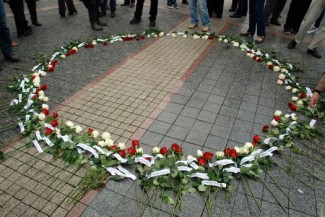
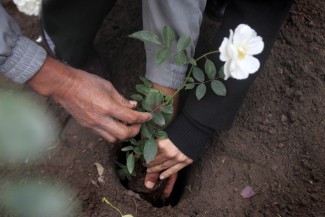
Two sets of hands plant a white flower in the ground.

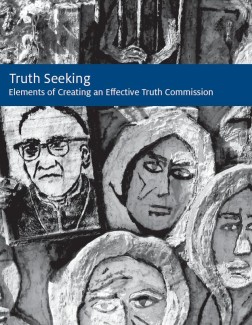
This publication provides an overview of the essential best practices guiding the main aspects of a truth commission, answering basic questions relating to its goals, powers, operations, framework, protections for commissioners and witnesses, and reporting. Its intention is to provide...

Truth commissions can provide a stage for a potentially powerful encounter with the past (and present) at the level of public discourse. While their capacity to effect transformation in societies marked by patterns of identity-related marginalization and exclusion is limited (and the ...

Since long before Russia’s full-scale invasion of Ukraine in 2022, Moscow has spread disinformation to justify its aggression, disguising their longstanding premises that Ukraine is, allegedly, not a sovereign nation, and its statehood is conditioned upon an alliance with Russia. Countering these narratives is not only valuable for Ukrainians, but also for buoying any democratic transformations in Russia and for establishing a more nuanced understanding of the history of Central and Eastern Europe.

As we search for ways to halt the violence and foster lasting peace in societies grappling with a legacy of massive human rights abuse, there is arguably no more important day to reflect upon the importance of the struggle for truth and justice than today, March 24. Thus, we take a moment to mark the International Day for the Right to the Truth concerning Gross Human Rights Violations and for the Dignity of Victims.

This year, ICTJ's campaign for the International Day for the Right to the Truth centers around the theme, “Truth is the Foundation of Justice.” This notion, fundamental to the idea of a comprehensive approach to justice, is explored through several new releases from ICTJ.

Perspectives of Colombians particularly affected by the country's conflict – women, young people, and indigenous peoples – who are demanding truth.

The International Center for Transitional Justice (ICTJ), in partnership with the Barcelona International Peace Resource Center (BIPRC), is pleased to announce its third Intensive Course on Truth-Seeking. Our 2011 course will focus on the relationship between peacebuilding and transit...

The International Center for Transitional Justice (ICTJ), in partnership with the Barcelona International Peace Resource Center (BIPRC), is pleased to announce its third Intensive Course on Truth-Seeking. Our 2011 course will focus on the relationship between peacebuilding and transit...

ICTJ hosted its third Intensive Course, Truth-seeking and the Challenge of Sustainable Peace, on September 26–30. Based on concrete field experience, the participants explored the relationship between truth-seeking and peace in societies that have experienced or are still experiencing armed conflict.

Join ICTJ as we co-host a delegation of RECOM’s leaders at two events in New York on November 14 and 15. They will share their experience campaigning for truth in the Western Balkans, present the draft mandate submitted to the presidents of the region, and discuss a successful public campaign that has gathered over 500,000 signatures in support of the commission.

Refugees and internally displaced persons (IDPs) have often been directly affected by the crimes truth commissions seek to expose, and have a major stake in the success of transitional justice processes, which can shape the stability of post-conflict communities as well as the prospec...

An internal armed conflict involving the government, leftist guerrillas, and a variety of paramilitary groups and criminal bands has endured in Colombia for the last 60 years, generating massive levels of displacement. A comprehensive truth commission that investigates major human rig...

The international conference on transitional justice 'Addressing the Past, Building the Future: Justice in Times of Transition' concluded today in Tunis, following two days of discussions on justice models and measures implemented in transitions. View the conference blog The conference explored...

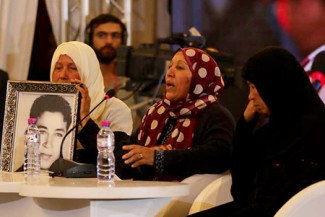
On January 14, Tunisia's Truth and Dignity Commission will resume public hearings. Salwa El Gantri outlines how ICTJ has worked with the TDC and civil society to amplify victims' voices.

As the Tunisian government takes firm steps to investigate human rights abuses committed since 1955, including under the Ben-Ali regime, ICTJ calls for care and attention in appointing members to the upcoming Truth and Dignity Commission.

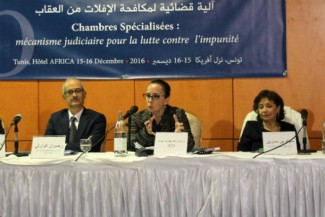
In Tunisia, efforts to seek criminal accountability have been characterized by an absence of strategy and the lack of political will. An ICTJ conference sought to address these issues and ease the confusion and political gridlock surrounding the Specialized Judicial Chambers.

As Tunisia concludes its final deliberations on the new constitution, transitional justice issues such as reparations for victims, truth about the past and the rights of women have been central to the legislative debates. Over the past month, ICTJ’s leading experts have been engaged with stakeholders on the ground on a variety of issues under deliberation, including truth-seeking, reparations, gender justice, and the role of children and youth.

In Tunisia, public hearings have fundamentally changed public dialogue about the past. The Truth and Dignity Commission will hold special session scheduled to coincide with the International Day for the Right to the Truth on March 24th. Watch live here:

The National Conference to Launch a Dialogue on Transitional Justice in Tunisia was held on Saturday, April 14 in Tunis, initiating a process which should result in the adoption of a comprehensive law on transitional justice by the country’s National Constituent Assembly. ICTJ president David Tolbert delivered a keynote address.

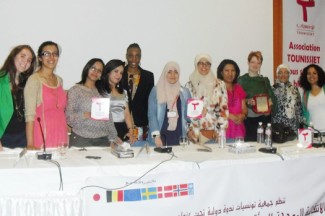
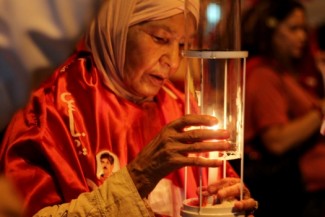
As Tunisia’s Truth and Dignity Commission (TDC) prepares to hear the testimonies of thousands of citizens, ICTJ is assisting women’s groups in ensuring that their voices are heard in the process.

The Tunisian government reintroduced a bill that, if passed, would grant a path for reconciliation to corrupt business people and Ben Ali-era officials. They claim it will stimulate the economy, but economics professor Dr. Abdeljelil Bédoui explains why this law is not the solution.

In this op-ed, ICTJ's President David Tolbert expresses concern about the new "Reconciliation Bill" proposed by the Tunisian government, which would grant amnesty to corrupt business people and Ben Ali-era officials in the guise of "reconciliation." "Massive corruption and violent human rights violations are mutually reinforcing, and unless this linkage is exposed and broken, it can lead to mutually reinforcing impunity," writes Tolbert.

In this interview, Judge Walid Melki explains how Tunisia's Specialized Judicial Chambers will investigate and prosecute serious human rights violations.

Hailed as one of the only success stories to emerge out of the Arab Spring, Tunisia is now facing a significant challenge to its democratic progress. On July 25, Tunisia’s president, Kais Saied, enacted Article 80 of the Tunisia Constitution giving him emergency powers to protect the country from imminent threats. He then used these powers to suspend parliament, lift parliamentary immunity, and fire the prime minister as well as the ministers of justice and defense.

This briefing paper details and analyzes the progress made so far in Tunisia to implement its historic Transitional Justice Law, with a particular focus on the Truth and Dignity Commission, created one year ago.

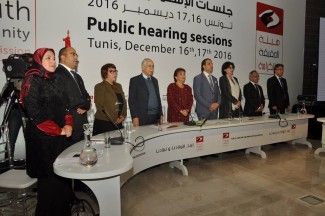
Following two days of historic public testimony last month, Tunisia's Truth and Dignity Commission's second set of public hearings continue. Watch the livesteam below and follow us on twitter at @theICTJ for live coverage.

As the work of Tunisia's Truth and Dignity Commission winds down, ICTJ's Salwa El Gantri and Kelli Muddell discuss some of the challenges and successes of its work and their vision for transparent, participatory processes to advance Tunisia’s transitional justice mandate in the short and long term.

ICTJ joins groups calling for an anti-terrorism approach that respects citizens' rights in Tunisia. “Institutional reform can be a strong tool to prevent recurrence of human rights abuses and build a strong and credible democracy in Tunisia," said Salwa El Gantri, ICTJ Head of Office in Tunisia. "The current transitional justice process aims to shed light on similar violations that took place under the dictatorship, and we don’t want them to be committed again under the ‘fight against terrorism’ slogan.”

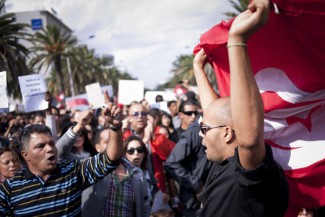
Tunisian activists have taken to the streets this month to protest the proposed Economic Reconciliation Law recently revived in parliament. If approved, the bill would offer a path for corrupt Ben Ali-era officials and business people to legalize their stolen assets and secure a form of amnesty.

Tunisia has faced many challenges since the launch of the National Dialogue on Transitional Justice two years ago, including political assassinations that rocked the process as well as a number of political blockages. Yet the Tunisian people came through a complex and challenging process and achieved important results — results that can provide the foundation to confront a long legacy of human rights abuses and pave the way towards a democratic transition built on the rule of law and trust between citizens and the state.

Nepal’s new local government structure – comprised of districts, municipalities, sub-municipalities, and wards formed within the new federal system under the 2015 Constitution – offers the possibility of some individualized redress for victims at the community-level. This article by Elena Naughton was published in the Kathmandu Post on May 6, 2018.

For more than 20 years, the Amnesty Law has hindered El Salvador from pursuing accountability for perpetrators of serious crimes committed against civilians during the civil war fought between the government and leftist insurgents in the 1980's. However, this may change in very near future. On September 20, the Constitutional Court admitted a petition claiming that the Amnesty Law passed in March 1993 –which shielded perpetrators of serious crimes committed during the 12-year civil war– is unconstitutional.