
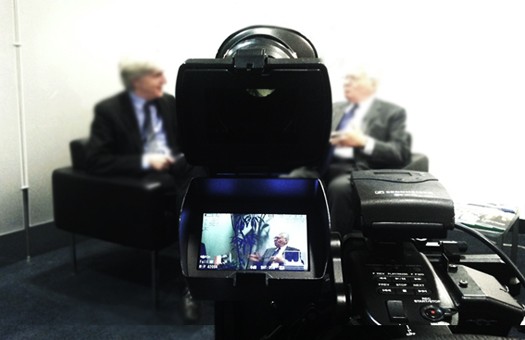
ICTJ is launching a multimedia page featuring projects that highlight the human perspective of issues in transitional justice and seek to engage a wide variety of audiences in a discussion on accountability for massive human rights abuses.
As we launch our new multimedia library, we want to hear from you: can multimedia effectively relay complex issues like transitional justice? Tell us your thoughts on Twitter.
Here are 5 reasons we think multimedia can play a key role in deepening public understanding of transitional justice, and convey the guiding principles of ICTJ.
### 1. It Starts a ConversationWhether because of recent political turmoil in Egypt or the ongoing peace process in Colombia, transitional justice is often the focus of public attention. At a local and national level, questions are being asked that speak to the core of ICTJ’s expertise. However, there are still many common misconceptions about the true meaning of transitional justice. ICTJ’s multimedia resources seek to directly engage a broad audience through compelling visual, audio and interactive content designed to spark new attention to the fundamental principles that form the foundations of transitional justice field.
For example, The Case for Justice uses the experiences of Colombia, Egypt, DRC, and Uganda to demonstrate the absolute necessity for accountability after serious crimes.
In the film, Hossam Baghat, one of the leaders of the revolution in Egypt, made a prediction that, over one year later, rings true: “Without this full and comprehensive process of justice and restoring dignity to the people, we are going to continue to live under the same practices and policies as we did under Mubarak—and in that case, a second revolution is just a must.” ### 2. It Tells a Human Story
“Victims are not numbers,” said Maria Camila Moreno, head of ICTJ’s Colombia Office. “They are people with flesh and blood, who have dignity.” The struggle of societies working to recover after conflict or dictatorship is comprised of remarkable human stories of courage, perseverance and strength.
Multimedia allows for complex concepts of transitional justice or the rule of law to be firmly rooted in the moving personal experiences of those most affected by transitional justice measures. It is with this in mind that we tell stories like that of Yoladis and Petronila in Voices of Dignity, as we know their search for justice and reparation in Colombia will inspire.
### 2. It Tells a Human Story
“Victims are not numbers,” said Maria Camila Moreno, head of ICTJ’s Colombia Office. “They are people with flesh and blood, who have dignity.” The struggle of societies working to recover after conflict or dictatorship is comprised of remarkable human stories of courage, perseverance and strength.
Multimedia allows for complex concepts of transitional justice or the rule of law to be firmly rooted in the moving personal experiences of those most affected by transitional justice measures. It is with this in mind that we tell stories like that of Yoladis and Petronila in Voices of Dignity, as we know their search for justice and reparation in Colombia will inspire.
3. It Goes Beyond the Headlines
By combining powerful footage, photography and interviews with activists and experts from around the world, multimedia can be a window into issues that deserve much more insight than a short news report can provide. Our multimedia library hosts archives of on-site interviews at major international conferences, as well as Q&A’s with the authors of major ICTJ reports. Through interviews, experts provide high-quality explanations of the principles behind transitional justice.
In our podcasts, we sit down to talk about themes of truth, justice and reparations with ambassadors and activists, academics and actors. For example, our monthly ICTJ Forum gathers ICTJ experts together for expert commentary and transitional justice analysis of breaking news and developments around the world.
4. It Asks the Hard Questions
After a dictator is overthrown, how can societies rebuild trust in their institutions? How can exposing past abuses help, instead of hinder, reconciliation? What are the consequences of granting amnesty to perpetrators of serious crimes? These complex questions are frequently part of transitional justice debates.
ICTJ’s multimedia projects frame these debates through a diversity of voices that bring global, comparative experiences to the table. For example, our film Peace and Justice confronts the false dilemma about whether justice needs to be sacrificed for the sake of peace and posits that sustainable peace is in fact impossible without accountability.
5. It Educates and Inspires
By explaining complex issues with compelling narratives, ICTJ’s multimedia can be used in the classroom as educational tools or as outreach tools for practitioners and activists. Often coupled with ICTJ’s publications and reports, our multimedia content is used for classes and trainings around the world.
For example, in order to visualize the rich detail of a new ICTJ publication, we designed an interactive digital platform, In Search of the Truth, to host the publication in an accessible way. And to present the ground-breaking studies on transitional justice and displacement, we designed an interactive map where users can learn and explore the findings of the project.
In the effort to illustrate diversity of the content available in ICTJ’s new library of visual, audio, and interactive online features, in the coming weeks we will spotlight several specific themes through our social media channels. We look forward to a discussion on how videos, podcasts and interactive platforms are effective tools to communicate issues usually reserved for reports and academic publications.To receive new ICTJ multimedia in your inbox, sign up for our newsletter.
Photo (top): ICTJ President David Tolbert interviews Thomas Buergenthal (Hannah Dunphy/ICTJ)

