
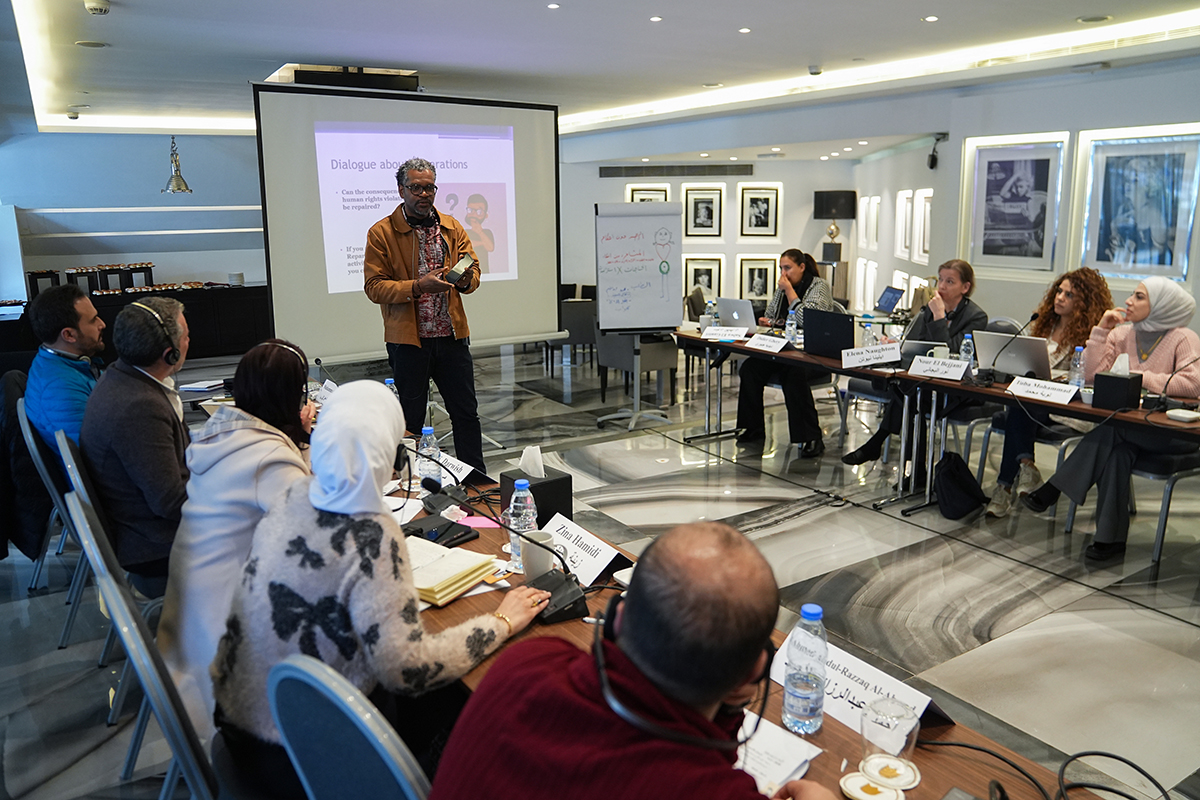
Fourteen members of Syrian civil society recently gathered for a five-day workshop on community facilitation and transitional justice organized by ICTJ and its partners in the Bridges of Truth project. The workshop marked a major step in the preparation for extensive community dialogues that will take place across Syria in the months ahead. These dialogues will build on similar ones held in late April 2025 in seven Syrian cities and towns, in which more than 130 residents from diverse backgrounds came together to discuss their needs and hopes for justice and reconciliation.
A collaboration of seven leading Syrian civil society organizations and ICTJ, the Bridges of Truth project raises awareness about the plight of detainees, the forcibly disappeared, and their families and advocates for justice for the innumerable victims of the Syrian conflict and the former regime’s repression.
The trainees were selected from these seven organizations and based on their potential to moderate sensitive group discussions in their communities about the atrocities committed during Syria’s devastating 14-year conflict and brutal dictatorship, and the path forward to justice and lasting peace. Senior experts and staff members from ICTJ and partner organizations led sessions on community engagement practices and wide-ranging transitional justice topics.
“At this moment in Syria, it is essential that communities themselves are equipped to lead conversations about justice, truth, and coexistence. This training is an investment in local leadership and in the possibility of a more inclusive future,” said Nousha Kabawat, head of ICTJ’s Syria program.
The workshop focused on the fundamentals of transitional justice alongside practical tools for leading inclusive and structured dialogues in communities still grappling with trauma, division, and uncertainty. The objective was to prepare a new crop of community facilitators capable of navigating these complex and emotionally charged conversations.
“Through this initiative, knowledge will be transferred to additional trainers, who will in turn pass it on to the wider Syrian community,” asserted Shadi Haroun, ICTJ’s Syria program coordinator. “Approximately 86 workshops are planned across various Syrian governorates to raise awareness of concepts related to transitional justice, targeting around 1,600 direct beneficiaries who will participate in these sessions.”
Structuring Inclusive and Trauma-Informed Dialogue
A central component of the training was how to design and facilitate dialogues that encourage open communication while remaining purposeful. Participants discussed setting clear objectives and collaboratively establishing ground rules that promote mutual respect, confidentiality, and active listening. Such a framework, they agreed, is essential when discussions may surface painful memories or strong disagreements.
Trainees practiced techniques for ensuring inclusive participation, managing dominant voices, and gently redirecting conversations that drift from the session’s objectives. They went over how to validate personal testimony while keeping discussions aligned with shared goals.
Recognizing that the community dialogues may surface deeply personal experiences, the workshop incorporated principles of mental health and psychosocial support as well as nonviolent communication techniques.
“In this training with young men and women from Syria, the objective was to introduce them to the principles of nonviolent communication,” explained Soha Fleyfil, a project officer at Pro Peace. “To achieve this, we began by discussing the concept of communication in general, exploring how participants understand it—whether as verbal or non-verbal communication.”
Participants explored the trauma and secondary trauma that victims typically experience. They also acknowledged that facilitators themselves may undergo emotional strain. Discussions highlighted the importance of preparation before sessions and intentional decompression afterward, along with practical strategies such as breathing exercises and structured breaks.
The trainees were reminded that community dialogues are not therapy sessions. Their role is to create conditions for participants to share perspectives and articulate needs, while remaining attentive to signs of distress and responding with care.
“People may come to these sessions carrying years of silence,” one participant reflected. “We must be ready to listen responsibly.”
Ethical considerations were also central to these conversations. Participants considered informed consent, privacy, and the risks associated with photography and social media in sensitive contexts. They stressed that consent must be voluntary and informed, particularly when dealing with youth and marginalized communities.
Incorporating Transitional Justice
Over the five days, participants explored core transitional justice themes, including truth seeking, criminal accountability, reparations, and institutional reform.
Discussions about the realities confronting Syria’s diverse population revealed that individuals and communities may have different understandings of truth and justice, shaped by their background, local context, and lived experiences.
“Justice means different things to different people,” one participant noted. “For a mother searching for her son, it is the truth. For someone whose home was destroyed, it may be rebuilding. For others, it is dignity.”
The workshop also stressed the importance of inclusion. Special attention was given to meaningful participation by women, youth, displaced persons, and marginalized communities, and to strategies for making dialogues more accessible and equitable.
“In this training, we learned the importance of preserving diverse narratives and working toward a shared space where stories from all sides—across regions and backgrounds—intersect and interact, ultimately contributing to a collective history built on this plurality of perspectives,” said Rana Sheikh Ali from Dawlaty.
Sessions on accountability addressed structural challenges facing Syrian institutions, including weakened judicial independence and limited capacity for fair trials. They also underscored sequencing reforms carefully to avoid undermining legitimacy.
Reconciliation was examined as a long-term process rather than a symbolic gesture. Participants cautioned against superficial arrangements that prioritize stability over justice. Genuine reconciliation, they agreed, requires acknowledgment of harm, accountability, and safeguards against recurrence.
From Reflection to Action
In the final days, the workshop shifted its focus from theory to practice. In breakout groups, participants designed model community dialogues tailored to different local contexts and tested ways to translate technical concepts into accessible language. They also developed plans for monitoring and evaluating future activities and coordinating support across partner organizations.
By the end of the workshop, the trainees had strengthened their facilitation skills, improved their knowledge of transitional justice, and formulated a shared vision for the community dialogues they will facilitate in the coming months. Through structured, inclusive dialogue, these trainers will offer rare opportunities for Syrians to speak openly about their experiences and aspirations for justice and lasting peace and help ensure that those most affected by years of repression and conflict will shape the path forward.
_________
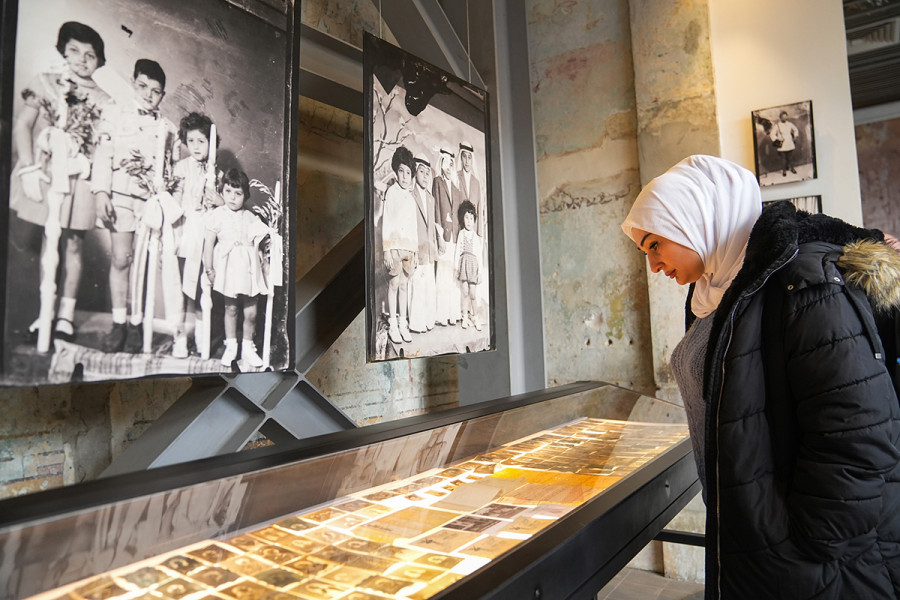
FEATURE PHOTO: A Syrian participant in the workshop, which was held in Beirut in mid-February 2026, visits a photography exhibition featuring victims from the Lebanese Civil War at the Beit Beirut Museum and Urban Cultural Center. (Mohamad Salman/ICTJ)

