
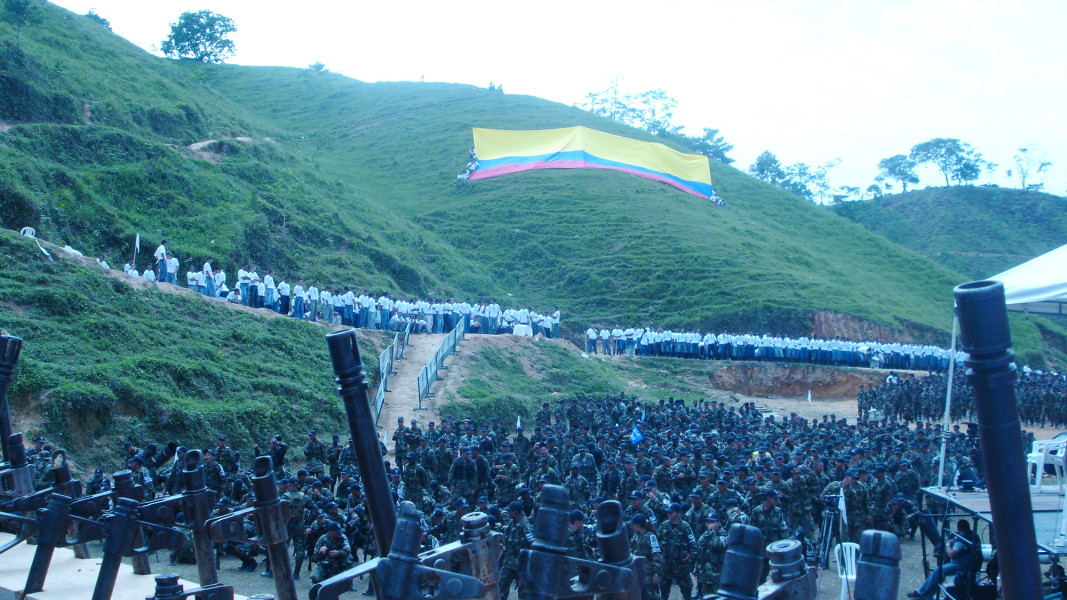
In 2005, Colombia passed the Justice and Peace Law, which established the country’s first formal transitional justice process. More than two decades have passed since the law’s enactment and the subsequent creation of a special criminal justice system to prosecute the serious crimes committed by paramilitary groups before their last mass demobilization in 2006.
To commemorate the anniversary, media outlet Verdad Abierta, the Friedrich Ebert Stiftung in Colombia, and ICTJ partnered to produce an investigative four-part series in Spanish that critically assesses Colombia’s first transitional justice experience. In an effort to share this incisive research with a wider audience, ICTJ has now translated the first two installments into English.
The first in series, this article provides an overview of the process, including its successes and limitations, and identifies its main achievements and challenges.
Wilson Salazar Carrascal, a member of the Frente Héctor Julio Peinado of the Bloque Norte, was the first of the more than 30,000 members of the Autodefensas Unidas de Colombia – AUC, a coalition of paramilitary groups that demobilized between 2003 and 2006, to give a versión libre, or voluntary account, to prosecutors of the Justice and Peace Unit on December 14, 2006. This unit had been established by Law 975 of 2005, also known as the Justice and Peace Law.
Two and a half years later, on March 19, 2009, Carrascal, aka “El Loro,” was convicted and received the first sentence handed down under this special criminal system. The demobilized paramilitary was found guilty of three assassinations, extortion, and falsification of public documents. His sentence of 38 years in prison was substituted with an alternative penalty of five years and 10 months.
While it appeared that this would open the doors to expedited sentencing of other demobilized AUC members, just the opposite occurred. The judicial ruling was appealed and was partially overturned by the Supreme Court of Justice on August 18, 2009. This decision was based in part on the fact he had not been prosecuted for criminal conspiracy, given that he belonged to an illegal armed group that had employed diverse strategies to systematically commit crimes.
In its ruling, the high court stated that “The criminal justice objectives set forth in the Justice and Peace Law refer to gross and systematic human rights violations. The prosecution and adjudication of these violations focus on the links to illegal armed groups (criminal conspiracy) and not, as asserted here, on the punishable conduct of individuals, as their investigation and sentencing would then fall within the jurisdiction of the ordinary courts.”
According to María Camila Moreno, head of the International Center for Transitional Justice (ICTJ) office in Colombia, “Justice and Peace began with the classic investigative approach used by the ordinary justice system, which is basically the sentence handed down to El Loro (convicted almost five years after the enactment of Law 975 and for only five crimes), and then had to modify the system’s initial design to provide its prosecutors and judges with effective criminal policy tools that would allow them to adapt their methodologies and approaches to the investigation and prosecution of macro-criminality.”
In other words, over time, it became clear that changes were needed to deal with the sheer scale of criminal acts, victims, and perpetrators. This task could not be addressed using the same logic and investigative approaches of the ordinary justice system.
The Supreme Court’s decision in the El Loro sentence was a landmark case that set an important precedent for the Justice and Peace authorities in terms of indictments and investigative approach. It also exposed the difficulties that the justice system, the victims, and the postulados (former combatants nominated for benefits under the Justice and Peace Law) would have to face to achieve the progress made in terms of justice, truth, and reparations that is evident today, 20 years later.
This ruling resonated with the Justice and Peace judges and prosecutors. Although the partial indictments and trials continued in some cases, it was a prelude to the reform of this transitional justice system that would be made a few years later.
After El Loro’s sentence was overturned, Luis González, then coordinator of the Attorney General’s Office’s Justice and Peace Unit, commented that his trial had been a sort of laboratory to create Supreme Court precedents and provide legal certainty to the postulados, allowing them to advance in the process. This former AUC member was finally convicted on June 27, 2016. (Read more in “Preocupación en Justicia y Paz por sentencia contra 'El Loro'.”)
This laboratory enabled the consolidation of what Juan Carlos Arias, current director of the Attorney General’s Office’s Transitional Justice Unit, considers the first serious transitional justice effort in Colombia.
“I would say that it has been extremely productive, that it has been very successful in terms of all we have learned: this process of understanding how to manage such a large volume of information, how it can be systematized with a macro-case perspective,” he says.
However, he also notes that progress has been limited: Only 10 percent of the criminal acts documented by the Attorney General’s Office in the thousands of crimes committed by the paramilitaries have been incorporated into the Justice and Peace rulings.
The Origins of the Justice and Peace System
In November 2001, when they held their fourth commander summit, the AUC began contemplating negotiations with the Colombian state. Why? Because the previous month they had been designated a foreign terrorist organization by the United States and because the trail of violence against civilians and their involvement in drug trafficking were becoming increasingly evident. (Read more in “Cómo se cocinó el desarme de las AUC.”)
Thus, this federation of more than 30 paramilitary groups around the country began to seek out contacts within the administration of then President Andrés Pastrana Arango. Their intentions, however, would not materialize until the next president came to power.
In his inauguration speech on August 7, 2002, incoming president of Colombia Álvaro Uribe Velez reiterated his intent to begin dialogue with illegal armed groups, provided they declared a unilateral cessation of hostilities. On November 29, after conversations with representatives of the Catholic Church and the Comisión Facilitadora de Paz de Antioquia, the illegal armed group announced its disposition to immediately begin dialogue with the national government, with the accompaniment of the Catholic Church, the Organization of American States, and the international community.
On December 23, the national government formed an Exploratory Peace Commission to promote and establish contact with the self-defense groups present in different regions of the country. The fact that the Autodefensas Campesinas del Magdalena Medio and the Bloque Metro requested a separate negotiation table speaks to the internal schisms within these organizations.
After much back and forth, on July 15, 2003, the Santa Fe de Ralito Agreement was reached in the municipality of Tierralta, Córdoba. This pact included the reintegration of the AUC to civilian life, as part of a process that would begin later that year and was expected to conclude in December 2005. To learn more about the origins of the Santa Fe de Ralito negotiations, listen to “Lo que (no) hemos aprendido,” the first episode of the podcast "El cascarón y la Semilla" (The Shell and the Seed), produced by ICTJ, about the lessons learned in the process with the AUC.
Luis Carlos Restrepo, then High Commissioner for Peace, was in charge of leading the process, which included the establishment of concentration zones for the demobilizations. However, this did not imply demilitarized areas like the ones created during the failed peace process with the FARC in San Vicente del Caguán.
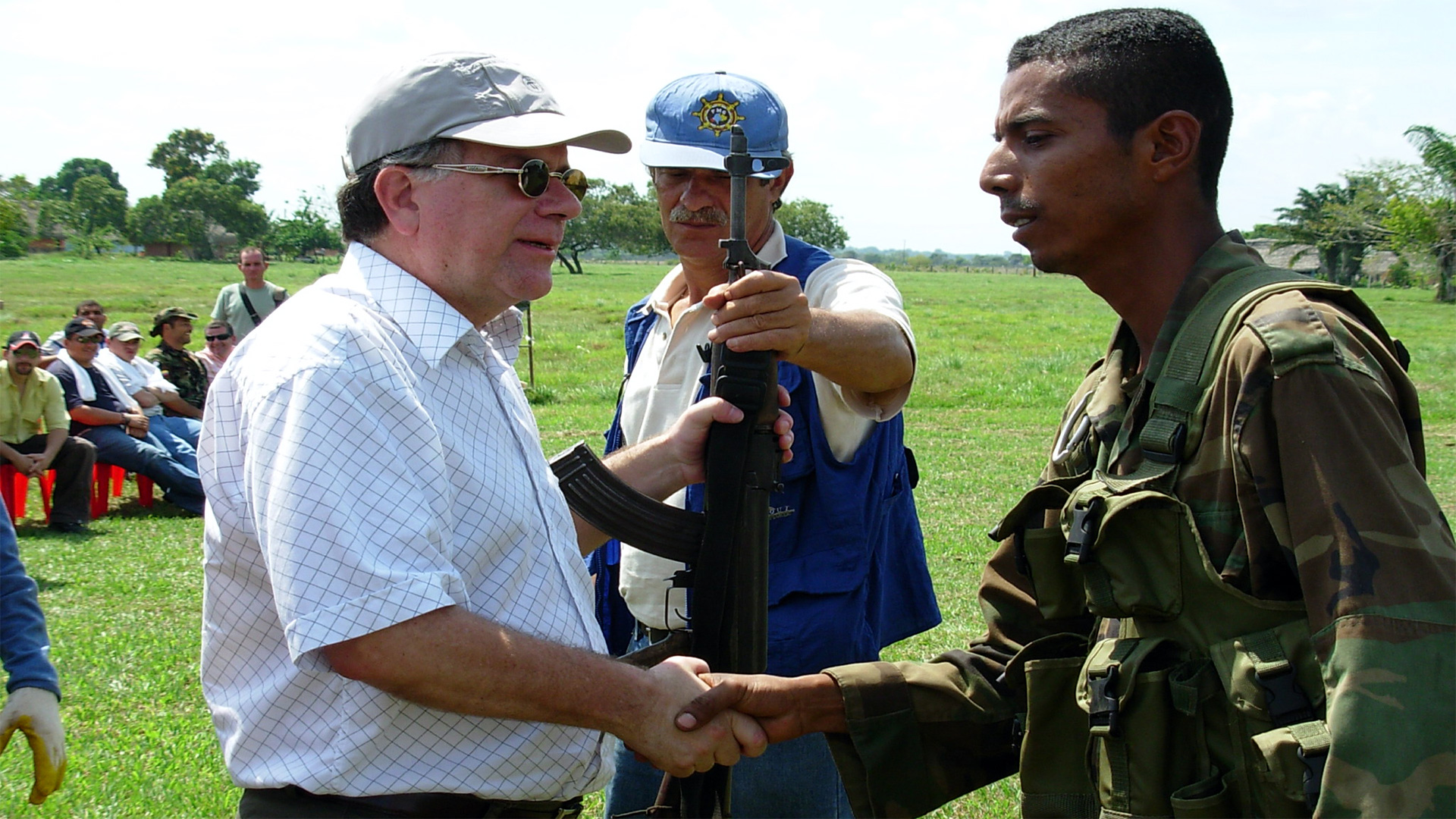
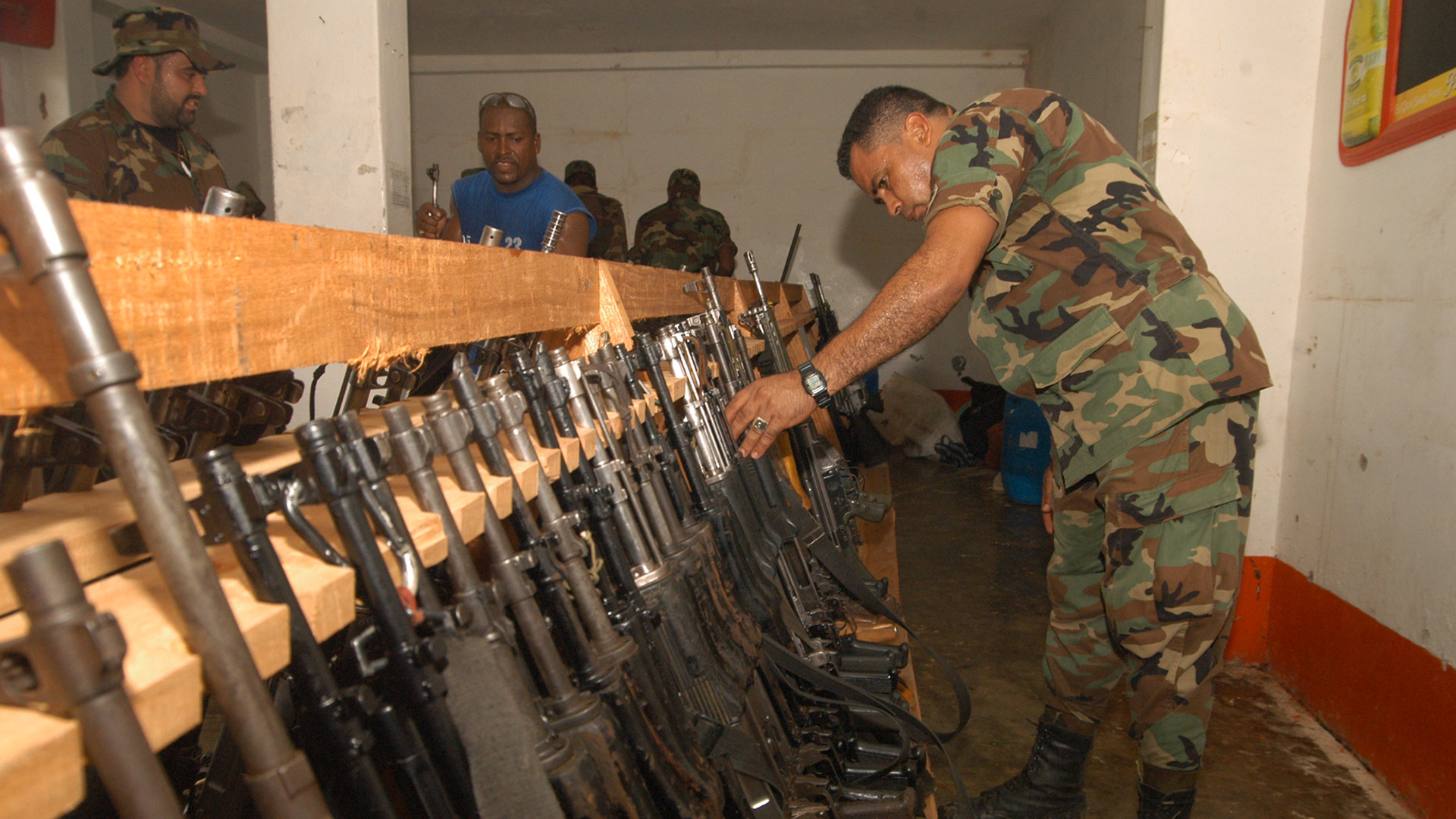
Following the roadmap for the demobilization, the AUC began surrendering their weapons in Medellín on November 25, 2003. The first group to do so was the Bloque Cacique Nutibara, under the command of Diego Fernando Murillo, alias “Don Berna.” According to the Office of the High Commissioner for Peace, 874 former combatants handed over 623 weapons. They were then moved to the neighboring municipality of La Ceja to begin their reintegration process.
By this time, the national government had already introduced a bill to the Colombian Congress that would establish a legal framework for prosecuting the crimes committed by former AUC members and for their reintegration into civilian life. The proposal received strong criticism because it did not contemplate prison sentences for those responsible for serious crimes and offered few guarantees for victims’ rights. After it was withdrawn, different actors promoted multiple alternatives that went up for debate. Law 975 was finally sanctioned in July 2005, including its controversial Article 71, which sought to classify membership in these armed groups as a political crime, namely sedition.
According to Adriana Arboleda, spokesperson for the Movimiento de Víctimas de Crímenes de Estado (MOVICE), this situation triggered a surge of activism that allowed the future Justice and Peace Law to be regulated in a manner more consistent with the principles of transitional justice, which must be victim-centered.
“Initially, before the enactment of Law 975, we conducted a campaign demanding that the paramilitaries effectively contribute to the truth as well as the modification of what was initially intended to be a ‘final settlement’ law, a law of total impunity. We also spoke before the Constitutional Court and participated in campaigns, efforts that led to a legal framework that reflected greater recognition of victims’ rights,” she remembers.
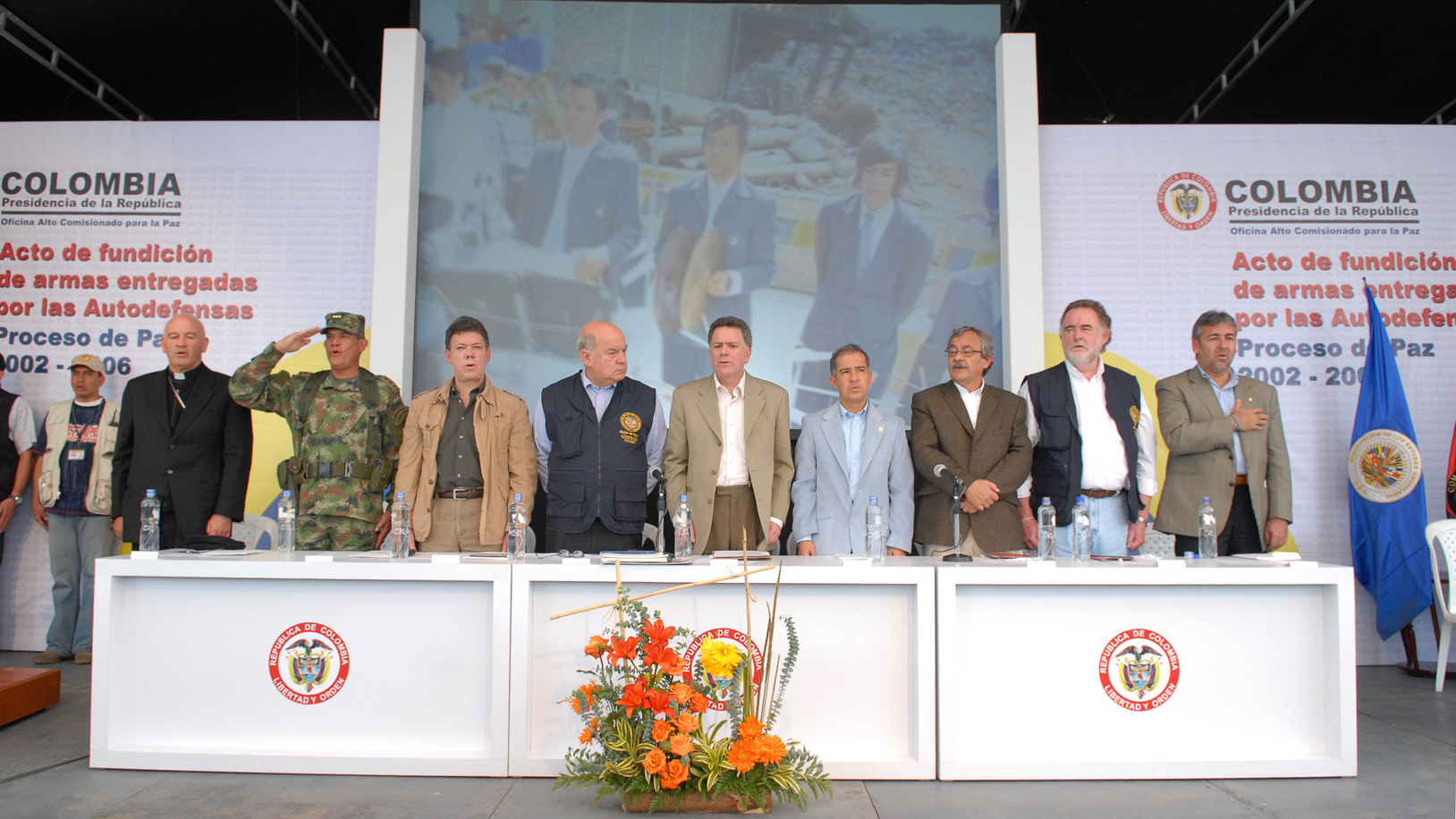
On July 25, 2005, Congress passed Law 975, also known as the Justice and Peace Law, creating the first transitional justice system in Colombia. Its mission was to investigate the perpetrators, reveal what had occurred during the armed conflict, provide reparations to the victims, and impose alternative sanctions on the postulados responsible for serious crimes. Thus, if a demobilized paramilitary who had been accepted into the Justice and Peace system fulfilled their commitments to truth, reparations, and non-repetition, they would be sentenced to 20 to 60 years in jail, depending on the gravity of their crimes; this sentence would then be substituted with an alternative sanction of between five and eight years in prison.
Exercising its constitutional oversight of Law 975, the Constitutional Court, in its Judgment C-370 (Sentencia C-370 de 2006), declared the article allowing paramilitaries to be treated as seditious as unconstitutional, thus closing the door to the possibility of recognizing the political nature of these structures. It also established criteria to safeguard victims’ rights: “The value of peace cannot be infinite in scope, as it is also necessary to guarantee the materialization of the core value of justice and of victims’ rights to justice, as well as other victims’ rights, despite the legitimate limitations imposed on them in order to end the armed conflict.”
This was a very significant judgment, as it changed the rules established for an important number of demobilized paramilitaries, who ended up facing criminal proceedings that required them to fulfill conditions, commitments, and obligations in order to receive alternative sanctions.
The first condition was that they appear before the Justice and Peace prosecutors, confess their crimes, and reveal the modus operandi of the illegal armed groups to which they had belonged. These confessions were made during voluntary accounts and were complemented with judicial police investigations and victims’ testimonies.
Subsequently, the Attorney General’s Office presented charges against them before a guarantees judge in one of the Justice and Peace courts that had been gradually established in the Superior Tribunals of Bogotá, Medellín, Barranquilla, and Bucaramanga. After concluding this phase of the process and conducting the corresponding investigations, hearings for the formulation and acceptance of charges are held before trial judges, followed by a comprehensive reparation act, in which the victims talk about their cases and request different measures to help them deal with the harm caused by the postulados. After these steps are completed, the judges finally issue their rulings. The Justice and Peace Chamber of Bucaramanga is the only one that does not hand down any rulings.
While the final articles of the Justice and Peace Law were being defined, a total of 38 ceremonies were held for the paramilitaries to voluntarily hand over their weapons. The last ceremony was held in August 2006, with the demobilization of the men remaining in the Bloque Elmer Cárdenas, which had been under the command of Freddy Rendón Herrera, alias “El Alemán.” According to the Office of the High Commissioner for Peace, 31,671 paramilitaries demobilized over a period of almost three years, surrendering 18,051 weapons.
However, even before the conclusion of the demobilization process, armed structures began appearing in areas where the self-defense forces had previously operated, with close links to drug trafficking and other criminal activity. The authorities called these groups "criminal gangs" (BACRIM), of which the Águilas Negras were the most prominent.
By 2006, the National Police had identified 33 BACRIM and, according to information collected for a case study by the Colombian Truth Commission, 477 demobilized AUC members had been assassinated.

To learn more about the AUC reintegration process and their commitments to Justice and Peace, read “El camino interminable de la reintegración.”
A Process of Trial and Error
At the end of the demobilization process and after the unsuccessful ruling against Wilson Salazar Carrascal, alias El Loro, the first definitive sentence was handed down under this transitional justice process. On June 29, 2010, Edwar Cobos Téllez, alias “Diego Vecino,” and Úber Enrique Banquez, alias “Juancho Dique,” both former commanders of the Bloque Héroes de los Montes de María, were convicted of several crimes committed by men under their command in this region of the Caribbean. These crimes included the Mampuján massacre, in María La Baja, a rural area of the Bolívar department.
While this sentence was welcomed, it was also cause for alarm. It revealed that the resources— accrued over seven years, beginning at the start of the demobilization process, in the Reparations Fund set up to compensate the victims with the money and properties handed over by the demobilized paramilitaries for this purpose—would be insufficient. Given that the cost of these reparations cannot be covered by the former paramilitaries, the Colombian state has the subsidiary obligation to repair.
The individual reparations set out in the sentence were based on the Inter-American Court of Human Rights’ rulings against Colombia. This Justice and Peace sentence determined that the paramilitaries would have to pay 240 million pesos to victims’ families for each homicide, up to a maximum of 40 million pesos for the surviving victims, and families would receive 120 million pesos in cases of displacement, i.e., 17 million pesos for each displaced person. The ruling also granted 30 million pesos in compensation to those who had been kidnapped.
The victims appealed the ruling, seeking better conditions. Not only was the case reviewed by the Supreme Court of Justice, but it also reached the Constitutional Court by way of a tutela or writ of protection of constitutional rights. Both courts concluded that it was impossible to provide legal redress to the thousands of victims in the Victims’ Registry and proposed a reparations scheme based on fixed amounts of compensation.
Subsequently, after the enactment of Law 1448 of 2011, also known as the Victims’ and Land Restitution Law, as well as Constitutional Court opinions on the issue of reparations, it was determined that the Justice and Peace Chambers would be responsible for ordering reparation measures to provide rehabilitation, restitution, compensation, satisfaction, and guarantees of non-repetition, in each specific case. Any other forms of reparation that did not stem from criminal proceedings would be adopted by the Victims’ and Land Restitution Unit.
For more information on this issue and how it was resolved, read the article “Dos décadas de esfuerzos de verdad, reparación y reconciliación.”
Adjustments: Between Minor Crimes and the Shift Toward Macro-Criminality
Although the Justice and Peace legal framework was a critical aspect of the transitional justice model, it is important to remember that it only covered a fraction of the demobilized former paramilitaries: Approximately 14,000 could not enter this procedure because their responsibility for serious crimes, such as massacres, displacement, disappearances, among others, was not proven, despite having been members of illegal armed groups. They were charged with other “minor” crimes, such as criminal conspiracy, illegal possession of firearms, or wearing police or military uniforms.
At the same time, given that members of these illegal structures could not be classified as political criminals (such as seditionists), they were not eligible for legal benefits, such as amnesties or pardons. In order to resolve this legal limbo, on December 29, 2010, the Colombian Congress issued Law 1424, which established an extrajudicial mechanism for these former combatants to appear before the Dirección de Acuerdos de la Verdad (Truth Agreements Division), directed by the Centro Nacional de Memoria Histórica, or CNMH (National Center for Historical Memory).
In exchange for legal benefits, these demobilized paramilitaries were required to provide information to the Truth Agreements Division about their participation in the armed groups, the orders they were forced to follow, and the crimes committed by the structures in which they were involved. With the information collected, the CNMH published several contextual, regional, and methodological reports about the modus operandi of the AUC. As reported by the Consejo Superior de la Judicatura (Superior Council of the Judiciary), 13,215 persons complied with the legal requirements of this law.
Several decisions were also made in 2012 to expedite the Justice and Peace process, which had in reality been operating on a case-by-case basis. This approach was not only unsustainable, given the volume of criminal acts and victims, it also made it difficult to understand the macro-criminal phenomena in their context. For this reason, the idea was to move toward a model of system crimes investigation.
This led to the enactment of Law 1592 of 2012. As noted by ICTJ in its report El enfoque de macro criminalidad en el proceso penal de Justicia y Paz, the new law incorporated a new way of investigating based on the identification of macro-criminal patterns, using methodological tools such as the “prioritization of cases,” as well as “context analysis” to reveal systematic phenomena. It also included the possibility of early sentencing as a mechanism to purge the system. In addition, it sought to simplify and expedite processes by reducing the number of hearings and including specific grounds for exclusion, among other changes.
According to ICTJ’s head of office in Colombia María Camila Moreno, the changes implemented in 2012 were a paradigm shift. “It was no longer individual crime, but rather organized crime, which implied a division of labor: a structure with people who make decisions, plan, and execute. There was an entire infrastructure to commit crimes with specific objectives, motivations, and logic behind them. And one can only reveal this infrastructure if one reveals the context.”
However, Moreno also explains that many flaws in the application of this new paradigm have become apparent over time. As noted in the ICTJ article, this was due in part because Law 1592 was designed and coexisted with a multiplicity of laws, decrees, directives, and memoranda that created an excess of definitions and elements in the criminal policy instruments, making them difficult for judicial authorities to understand and apply.
In this regard, Rubén Pinilla Cogollo, former judge of the Justice and Peace Chamber of Medellín, recalls many arguments with the Attorney General’s Office when constructing the patterns of macro-criminality. “They believed that the pattern was the sum of a certain number of homicides. But they did not reveal the policies underpinning those homicides (how and why they were ordered),” he says.
“The patterns of criminality or macro-criminality are simply a way of uncovering the systematic nature of the crimes,” he adds. “It is a tool for understanding that this was part of a policy, because the patterns of criminality reveal the policy behind the crimes. Not only to establish what the crimes are and the repetition of these crimes, which is merely one aspect of systematicity, but also to expose the responsibility of those at the highest level of the macro-criminal structure.”
In any case, prosecutor Arias indicates that the shift toward the macro-criminal approach was crucial for the investigations in the Justice and Peace system. “Here there have been processes with such a large volume of information that would otherwise have been impossible to discover in the ordinary justice system,” he says. ”We are talking about many, many criminal acts, easily 300,000, and about 800,000 or 900,000 victims.”
To learn more about this topic, read the article "Many Truths Revealed, But More to Come."
Much More Than Numbers
According to the Attorney General’s Office’s Justice and Peace Information System, as of May 2025, 4,477 former members of paramilitary groups and guerrilla organizations entered this transitional justice system.
According to the Attorney General’s Office, of these, 1,490 remain active, 2,709 decided to discontinue their process, and 278 were expelled for noncompliance with the legal requirements. However, on March 20, 2025, during the forum 20 años de la Ley de Justicia y Paz en cifras carried out by the National Comptroller’s Office, Alexandra Valencia, a trial judge of the Justice and Peace Chamber of Bogotá, noted that the number of expelled postulados was 489. This reveals the conflicting opinions of two authorities of this transitional justice system.
For almost 19 years, the Justice and Peace prosecutors have received testimonies from the postulados during more than 40,000 individual and group sessions. Their statements were crucial for documenting thousands of previously unknown crimes that had not been denounced by the victims at the time for fear of retaliation, or because the ordinary justice system lacked the tools to conduct the investigations.
Thanks to these confessions, and to the information provided by the victims from different regions of the country and the investigations carried out by the Technical Investigation Unit, the Attorney General’s Office was able to bring charges against 1,358 postulados for 146,084 acts of victimization before the judges of this special criminal procedure.
Nine of the 91 sentences issued by the Justice and Peace Chambers of Bogotá, Medellín, and Barranquilla were appealed and are awaiting a second instance ruling by the Supreme Court of Justice. Of the total number of sentences, 84 were issued against former members of paramilitary groups and seven against former guerrilla combatants who had also accepted the jurisdiction of the Justice and Peace Law. It is important to mention that these were partial rulings that covered a total of 841 postulados and 14,910 criminal acts. (Several crimes may have been committed in each act.)
In addition, 28 very advanced processes have completed the comprehensive reparations phase, in which sentences may be handed down. These rulings would cover 551 postulados, 8,986 criminal acts, and 31,600 victims.
The Justice and Peace judicial apparatus, as a whole, has avoided impunity for thousands of crimes and cases that had been gathering dust in archives. In addition, despite these partial results, judicial analysts and operators agree that the important contributions of this transitional justice system have led to a better understanding of the logic of the armed conflict and helped develop a methodology, fine-tuned over time, for processing large volumes of crimes, thus establishing multiple truths that had remained hidden for decades.
Despite the difficulties in the implementation of Law 1592 of 2012, judge Valencia believes that after this reform Justice and Peace began to operate with the logic of a transitional justice system. “Applying concepts such as patterns of macro-criminality and context provided a much more satisfactory explanation of what we—or the system—should understand as the prosecution of systematic and widespread crimes,” she says.
She goes on to explain that after the reforms and regulatory decrees that strengthened the Justice and Peace Law, the sentences handed down reveal “patterns of macro-criminality, such as the murder of protected people, forced disappearance, illegal recruitment, gender-based violence, forced displacement, and other conducts governed by international humanitarian law, such as physical or moral coercion against protected persons or food shortages, all of which are absolutely innovative in the domestic justice system.”
María Isabel Arango, trial judge and president of the Justice and Peace Chamber of Medellín, underscores that the judicial dimension of the process began to gain momentum 13 years ago, when the previously mentioned reforms were enacted and the new chambers began operating.
“In 2009 there were six guarantees judges working in Barranquilla and Bogotá. After the enactment of Law 1592 of 2012 and Decree 3011 of 2013, the [Justice and Peace] Chamber of Medellín was established as well as the trial chambers as such,” she says.
And she adds, “In late 2012, the trial chambers began to receive indictments from the Attorney General’s Office. Thus, the trial chambers, responsible for preparing the sentences, really only began operating in 2012. Prior to that there is a guarantees process: detention measures, indictments, and other matters that precede the trial itself.”
Arango concludes telling us about her experience as a judge. “Today there are 10 trial judges: three in Barranquilla, four in Bogotá, and three in Medellín. And although there are only 10 of us, we have made significant progress on this issue. We, especially those of us who have been here since the beginning, have had to work with practically nothing. If we had had even a quarter of the resources that the Special Jurisdiction for Peace has, we would have been able to work wonders, but with great effort we have done what we can, we have tried, and we have persevered.”
The president of the Justice and Peace Chamber of Barranquilla, Romel David Arévalo, also emphasizes that this transitional justice system has gone from being an experiment to a benchmark. “It is gratifying to see that what was once considered a judicial experiment, a replica of international tribunals such as those for Rwanda or Sierra Leone, has today become a global benchmark because we have handed down more sentences than all the tribunals created for different conflicts.”
And he adds, “Let us remember that transitional justice always arises for the purpose of leaving a conflict behind and achieving a peaceful society, healing wounds, telling the truth, compensating the victims, but also achieving social justice. And I believe this social justice is achieved by revealing the paramilitary phenomenon in Colombia. This is what we have been working on, and I believe we have accomplished the task.”
He also adds that this complex task has been “accomplished not based on the sophism that the Justice and Peace Law is very old, that it was supposed to be transitional and we have been working for 20 years and have still not achieved results. It is not that we have not achieved results, the results are there, but there is still a long way to go. In how investigations are conducted in Colombia, in how victims are compensated in Colombia, there is still a very long way to go.”
In terms of truth, the work of the Justice and Peace prosecutors and judges has revealed the systematic practices of the paramilitary groups, such as the use of crematory ovens to disappear their victims; land dispossession; alliances between paramilitary groups and members of the public security forces to commit the “false positives,” or extrajudicial executions; the use of sexual violence as a weapon of war; the "parapolitics" phenomenon, the symbiosis between the Convivir and paramilitarism; and the extermination of the members of the Unión Patriótica party, which has been classified as a political genocide, among others. In addition, more than 15 years ago, they alerted about the murder victims buried in La Escombrera in Medellín's 13th Commune, a situation that had been covered up for several years until the Special Jurisdiction for Peace took action on the matter.
This overview illustrates how the Justice and Peace system, which began as a transitional justice laboratory, was perfected over time by the decisions of the courts, the Attorney General’s Office, and the judges themselves. It has become a special criminal justice system that has laid the groundwork for the prosecution of system crimes, in response to the large numbers of crimes, victims, and perpetrators left by Colombia’s prolonged armed conflict.
And there is still a long way to go, which must be resolved in the pending rulings. Nonetheless, the implementation of this transitional justice system set an important precedent. It revealed the importance, in contexts of mass violence, of adopting a system crimes investigation approach to effectively prosecute those most responsible, using criminal policy instruments to ensure an understanding of the macro-criminal phenomena as a whole, beyond individual acts. It also demonstrated that fully achieving truth, reparations, and non-repetition is not a purely criminal justice effort, as evidenced by the work of the Truth Agreements Division and the Victims’ Law. For this reason, it will continue to be a benchmark for the design and organization of transitional justice models.
_____________
FEATURE PHOTO: Courtesy of MAPP/OAS Audiovisual Archive.

