

As the third anniversary of the brutal war in Sudan comes upon us, it may barely register amid the worrying succession of global crises, each carrying its own burden of human suffering. Whether you are far from the Sudanese conflict or closer to it, whether you know little or much about it, this is a moment to take some distance from the unrelenting news cycle —if only briefly—and reflect on a war that rarely receives the media attention it deserves. It is a time to consider the millions of Sudanese caught in cycles of violence, and the many among them striving for justice against the odds.
The war in Sudan has become a forgotten one. Despite its staggering magnitude and impact, the conflict is receiving little global attention. Sudan is the world’s worst humanitarian, health, and displacement crisis. Since April 15, 2023, fighting between the Sudanese Armed Forces and the Rapid Support Forces has killed hundreds of thousands of people and displaced over 14 million others within and outside of Sudan. Reports alleging genocide and ethnic cleansing continue to emerge. Famine has been declared in multiple areas and 21 million Sudanese are now facing acute food insecurity, while the health system lies in ruins. Sexual violence is being used as a weapon of terror across Sudan, mostly against women and girls.
The war in Sudan is recurrent. The atrocities being committed in Sudan today are part of a broader and repeated pattern of violence deliberately targeting the local population. This appalling repetition proves that the root causes of violence and injustice have remained fundamentally the same for decades and were never truly addressed during previous peace processes.
The war in Sudan is not local. Several countries in the region and beyond are fueling the violence, further undermining stability in an already fragile part of the world.
It is a war perpetuating exclusion. Previous peace talks have failed because they excluded victims, imposed peace based on elite bargaining, and ignored the pressing need for accountability, truth seeking, systemic institutional reforms, and reparations.
It is a war of shifting values and alliances that makes trust and the architecture for peace harder to build. Failing to recognize this reality risks placing the wrong actors at the negotiating table while excluding those who truly represent, listen to, and serve broader communities beyond their own circles—actors committed to justice and democracy for all citizens.
It is a children’s crisis. The Sudanese today who are being attacked or forced to fight, or who were scarred in previous decades of violence, do not even know what peace looks like. As a result, they repeat old violent patterns. Millions of children have spent the past three years of their lives deeply traumatized—displaced from their homes, injured, or separated from their families. An estimated eight million are currently out of school. This denial of education on a massive scale threatens an entire generation and could undermine Sudan’s recovery for decades to come, as was the case with their parents and grandparents.
Paradoxically, this is also a war marked by rays of hope. Despite immense humanitarian needs, victims and civil society have remained steadfast in demanding accountability, placing transitional justice at the center of their struggle. They see it as essential to breaking cycles of violence. Their message is clear: They will not trade justice for short-term relief. In working alongside them for years, we at ICTJ have seen their determination to shape a more just and inclusive Sudan and to develop the skills to make it possible. For this reason, they are ready to participate meaningfully in peace negotiations. Their contribution is key to ensuring the credibility and legitimacy of peace agreements and transitional justice measures for years to come.
The gravity of the situation in Sudan calls for collective responsibility. This means not sidelining victims as mere recipients of aid, but recognizing them as political actors. It also requires engaging those who genuinely represent diverse and marginalized communities and placing justice at the center of any path to peace. The time to invest in transitional justice, dialogue, and broad consultations is now. It is also imperative to remain engaged even when domestic or global conversations about the future of Sudan become difficult, because it is precisely in those moments that democracy begins.
______
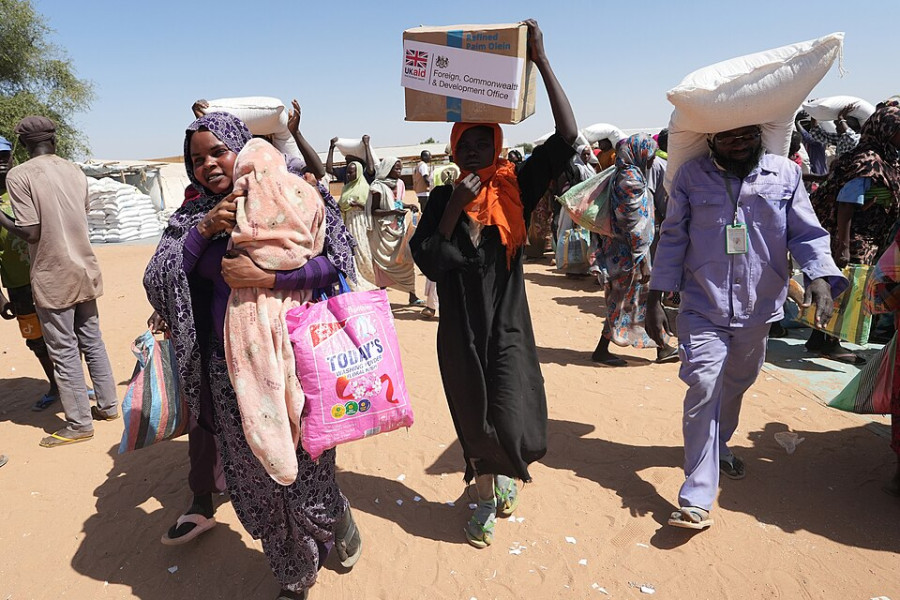
PHOTO: Sudanese refugees in Adré, eastern Chad, collect humanitarian aid on February 3, 2026. Before the war broke out in Sudan in April 2023, the town of Adré had a population of 40,000. Today, it hosts over 180,000 Sudanese refugees. (Russell Watkins/UK Foreign, Commonwealth and Development Office)

