51 results

2020 was a year of unforeseen hardships throughout the world. We may wish to write off last year as a loss and move forward. However, looking back on it as we do in this 2020 Year in Review, in which we highlight our most read content, we can find and take heart in important victories and apply lessons learned in 2021 and beyond.

In 2021, there were significant developments, some hopeful and some devastating, in the struggle for truth, accountability, and redress in countries around the world. ICTJ experts covered these events in commentaries and feature stories published on our website and in our newsletters. While 2022 is already underway and we at ICTJ are hard at work, we would like to pause a moment to take stock and reflect on the year that was.

Throughout 2023, ICTJ’s experts have offered their unique perspective on breaking news around the globe as part of the World Report. Their insightful commentaries have brought into focus the impact these events have on victims of human right violations as well as larger struggles for peace and justice. In this edition, we look back on the past year through the Expert’s Choice column.

ICTJ is launching a new multimedia page featuring projects that highlight the human perspective of issues in transitional justice and seek to engage a wide variety of audiences in a discussion on accountability for massive human rights abuses. Here's why we think multimedia can play a key role in deepening public understanding of transitional justice, and convey the guiding principles of ICTJ.

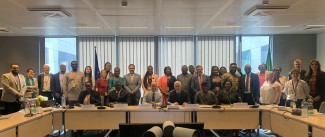
On June 5 and 6, 2024, the African Union (AU) and the European Union (EU) hosted the fourth edition of the AU-EU Experts’ Seminar on Transitional Justice in Brussels, Belgium. The consortium implementing the Initiative for Transitional Justice in Africa, led by ICTJ, helped organize the event. The seminar explored how transitional processes can transform individual lives, societal relations, and dysfunctional state institutions.

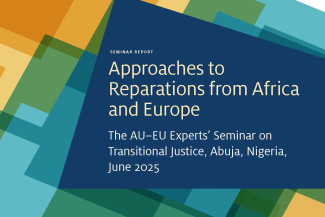
The AU–EU 2025 Experts’ Seminar on Transitional Justice convened African and European practitioners to advance reparations as a central pillar of transitional justice. Discussions highlighted legal obligations, victim-centered and transformative approaches, and persistent challenges i...

Cover featuring an abstract design for the report "Approaches to Reparations from Africa and Europe: The AU–EU Experts’ Seminar on Transitional Justice, Abuja, Nigeria, June 2025"

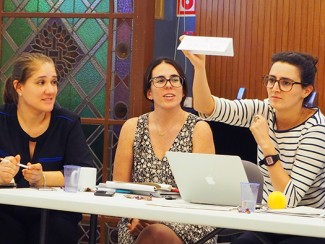
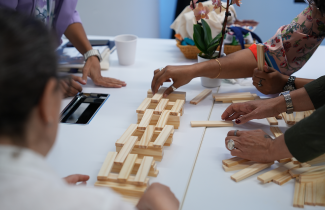
From October 1 to October 5, 2018, ICTJ hosted its eleventh intensive course on transitional justice in collaboration with the International Peace Center for in Barcelona. Participants included leaders in their respective fields, including human rights law, community justice and legal services, peacebuilding, education, and humanitarian affairs.

Long before ICTJ existed, societies everywhere wrestled with the justice-related dilemmas caused by violent conflict, and victims, communities, and courageous leaders found answers of their own. What was missing was a place where people who took part in those different experiences could meet, share knowledge and lessons, and build a community to respond together to the evolving challenges to justice and peace. In 2001, ICTJ was created to be that place and to catalyze a collective effort to address massive human rights violations and build a peaceful, inclusive, and just future.

At a time when truth-seeking and reparations initiatives are taking hold across the United States, this report offers reflections from various civil society-led truth-seeking processes. Drawing on case studies from the United States, Colombia, Scotland, and West Papua, the report iden...

People gather around a plaque marking the Greenboro Massacre outside during an inaugural ceremony

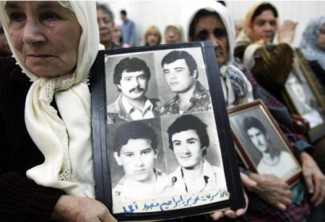
Enforced disappearances are among the cruelest of crimes. To the kidnapping, torture, and in many cases, murder of the victim, perpetrators intentionally create fear and uncertainty about the fate of the missing person. Although men are predominantly targeted, the impact on women is severe and lasting.