5 results

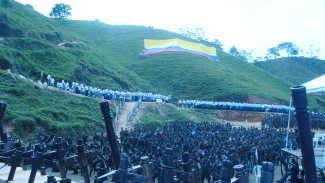
To commemorate the 20th anniversary of the Justice and Peace Law—which created Colombia's first transitional justice system—media outlet Verdad Abierta, the Friedrich Ebert Stiftung, and ICTJ partnered to produce an investigative four-part series in Spanish that critically assesses its legacy. Now translated into English, this first installment provides an overview of the process.

The field of transitional justice is increasingly recognizing the relevance of mental health and psychosocial support (MHPSS) in contexts of massive human rights violations. Despite growing advocacy and awareness at the global policy level, however, the field lacks a systematic approa...

an image of colorful painting featuring a young girl

ICTJ was pleased to host the newly elected United Nations Special Rapporteur on the promotion of truth, justice, reparations, and guarantees of non-recurrence, Fabian Salvioli (Argentina), at its New York office, where he discussed his vision and priorities.

NEW YORK, March 15, 2012—Brazilian federal prosecutors announced yesterday that they have opened a criminal investigation against a military officer accused of the enforced disappearance of civilians during the 1964–1985 military dictatorship. This is a welcome blow against the use of a 1979 amnesty law to shelter government agents who committed horrific crimes against civilians from accountability.

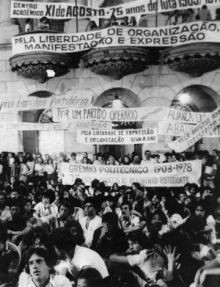
Although Brazil's dictatorship ended years ago, focus on transitional justice there is peaking now, as debate stirs over how to best address its past. Recent developments - including the Brazilian government's proposal of a truth commission, the opening of national archives, and the Inter-American Court of Human Rights' decision limiting the 1979 amnesty law - are at the core of the discussion. Eduardo Gonzalez, director of ICTJ's Truth and Memory Program, discusses the role accountability for the past can play in Brazil today.