

On March 25, 2026, the UN General Assembly adopted a resolution recognizing the enslavement of Africans as the gravest crime against humanity. Introduced by Ghana, the resolution garnered the support of 123 UN member states, although the United States, Israel, and Argentina voted against it, and 52 other states, including the United Kingdom, Canada, and all European Union member states, abstained.
The assembly adopted the resolution during the commemoration of the International Day of Remembrance of the Victims of Slavery and the Transatlantic Slave Trade. Beyond declaring the racialized chattel enslavement and trafficking of Africans as the gravest crime against humanity, the resolution also affirmed the right of Africans and people of African descent to reparations for this crime, including compensation, restitution of cultural property, formal apologies, and other reparatory measures.
The resolution is an integral part, if not the culmination, of a wider push by African states for reparations for historical injustices, including the transatlantic slave trade, colonialism, apartheid, and genocide. This long-running campaign to rally African states around demands for reparations for historical injustices includes the 1993 Abuja Proclamation on Reparations and the 2023 Accra Proclamation on Reparations. These efforts also led the African Union (UN) to declare 2025 the “Year of Justice for Africans and People of African Descent Through Reparations” and the AU Executive Council to designate 2026 to 2036 as the AU Decade on Reparations.
The AU’s Transitional Justice Policy (AUTJP), adopted in 2019, affirms the connection between reparations for historical injustices and transitional justice in Africa. The AUTJP calls for a holistic approach to transitional justice that addresses both contemporary violations of human rights and humanitarian law and the legacies of exclusion and historical injustices. Yet, in practice, demands for reparations for historical injustices appear to have remained disconnected from transitional justice discourse in Africa. Advocacy for these reparations has predominantly been outward-looking, focusing on violations committed by external actors from Europe and elsewhere in the past, while transitional justice has largely been inward-looking.
This distinction is understandable, given that redress for historical injustices often involves demands directed at former colonial powers and beneficiaries of slavery. That said, African states must also confront their own histories of violence, exclusion, and marginalization. The same structural inequalities, patterns of impunity, and forms of political and economic exclusion that underpin claims for reparations for slavery, colonialism, and other historical injustices continue to shape contemporary experiences of conflict, repression, and injustice across the continent.
As such, the adoption of the UN General Assembly resolution recognizing slavery as the gravest crime against humanity presents an opportunity to foster a broader culture of accountability in Africa. Such a culture would be founded on the same rejection of impunity for gross human rights violations and egregious crimes against humanity upon which claims for reparations for historical injustices are premised.
Reparations for historical injustices and transitional justice should therefore not be seen as separate or competing agendas, but rather as mutually reinforcing imperatives. The pursuit of justice for Africans and people of African descent does not end with redress for historical wrongs. It is inseparable from contemporary struggles for truth, justice, reparations, and guarantees of non-recurrence. All are grounded in the affirmation that “a crime does not rot,” a cardinal principle affirmed in the recent UN resolution.
__________
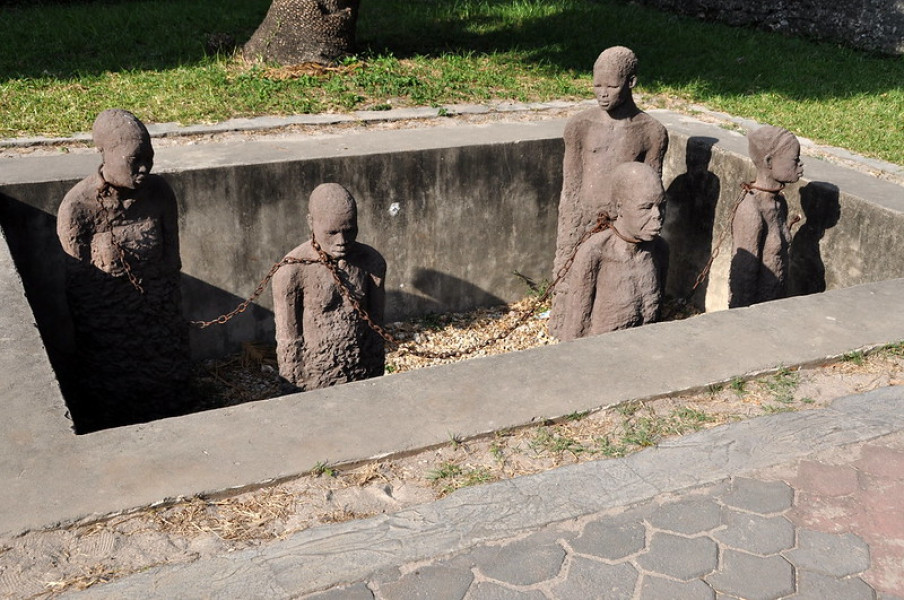
PHOTO: The Slavery Memorial in Zanzibar, Tanzania, is located in Stone Town at the site of the former East African slave market. Created by Swedish artist Clara Sörnäs in 1998, it commemorates the thousands of enslaved people sold there. (Kevin Harber/Flickr)

